

Elaine Fahey is Professor of Law and Jean Monnet Chair in Law and Transatlantic Relations at City Law School, City, University of London, UK and Isabella Mancini is Lecturer in Law at Brunel Law School, Brunel University London, UK.
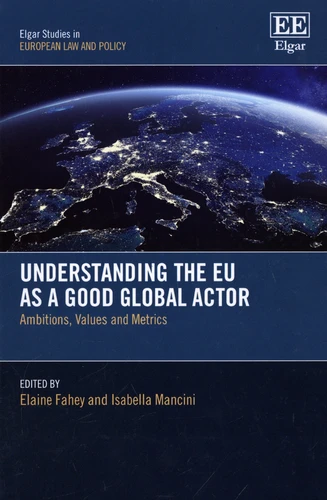
Understanding the EU As a Good Global Actor. Ambitions, Values and Metrics
Par : ,Formats :
- Paiement en ligne :
- Livraison à domicile ou en point Mondial Relay estimée à partir du 8 octobreCet article sera commandé chez un fournisseur et vous sera envoyé 23 jours après la date de votre commande.
- Retrait Click and Collect en magasin gratuit
- Nombre de pages304
- FormatGrand Format
- PrésentationRelié
- Poids0.63 kg
- Dimensions16,0 cm × 23,0 cm × 2,0 cm
- ISBN978-1-80220-297-7
- EAN9781802202977
- Date de parution01/10/2022
- ÉditeurEdward Elgar Publishing
Résumé
This timely book investigates the EU's multi-faceted development as a global actor, unpacking its legal mission to be a 'good' actor as well as exploring the complexities of fulfilling this objective. It elicits critical reflections on the question of 'goodness' in EU external relations from descriptive, analytical and normative perspectives, and examines which metrics of actorness are useful in tackling this subject.
Featuring contributions from more than 20 leading EU scholars and emerging voices, the book develops four themes through which it advances a research agenda for the study of the EU as a good global actor. The book begins by unpacking the complexities of the EU as a global trade actor, before discussing 'good' trade governance and a deeper trade agenda, the issue of data governance in digital trade and in other regulatory frameworks, and finally, the institutional dimension of EU actorness.
Understanding the EU as a Good Global Actor will be a crucial read for scholars and students in EU law and politics, particularly those with an interest in EU governance, trade and external relations. It will also prove useful for policy makers both within and outside the EU.
Featuring contributions from more than 20 leading EU scholars and emerging voices, the book develops four themes through which it advances a research agenda for the study of the EU as a good global actor. The book begins by unpacking the complexities of the EU as a global trade actor, before discussing 'good' trade governance and a deeper trade agenda, the issue of data governance in digital trade and in other regulatory frameworks, and finally, the institutional dimension of EU actorness.
Understanding the EU as a Good Global Actor will be a crucial read for scholars and students in EU law and politics, particularly those with an interest in EU governance, trade and external relations. It will also prove useful for policy makers both within and outside the EU.
A propos de Elaine Fahey
The Global Reach of EU Law
Grand Format
48,60 €