
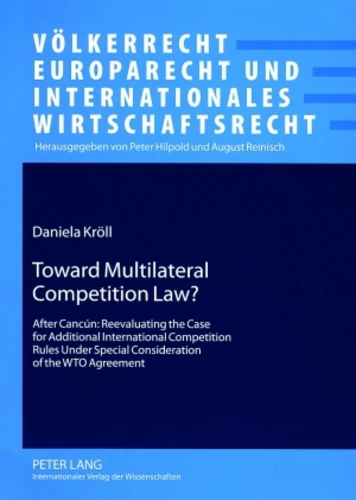
Toward Multilateral Competition Law?. After Cancún: Reevaluating the Case for Additional International Competition Rules Under Special Consideration of the WTO Agreement
Par :Formats :
- Nombre de pages218
- ISBN978-3-631-56120-1
- EAN9783631561201
- Date de parution01/07/2007
- CollectionVölkerrecht, Europarecht und I
- ÉditeurPeter Lang
Résumé
In 2001, the Doha WTO Ministerial Declaration recognized a "case for a multilateral framework to enhance the contribution of competition policy to international trade and development". Yet, the negotiations on additional multilateral competition rules within the WTO were formally suspended in 2004. This book aims at providing a comprehensive overview of the current status of the discussion and is intended to suit both the advanced reader and any reader with a general interest in international economic law.
The author critically reevaluates and reconfirms the case for additional international competition rules from both a competition and trade policy perspective. Taking into account the political developments around the failed Cancún Ministerial Conference and the relationship of competition policy and economic development, the author also illustrates a possible solution to break the deadlock concerning additional international competition rules within the ambit of the WTO.
The author critically reevaluates and reconfirms the case for additional international competition rules from both a competition and trade policy perspective. Taking into account the political developments around the failed Cancún Ministerial Conference and the relationship of competition policy and economic development, the author also illustrates a possible solution to break the deadlock concerning additional international competition rules within the ambit of the WTO.