

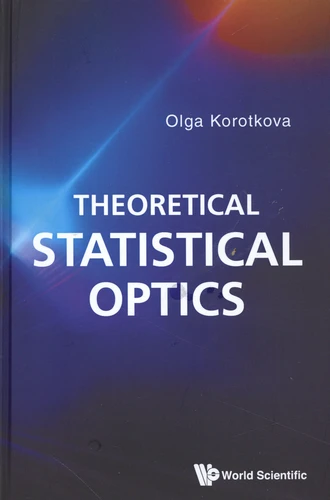
Theoretical Statistical Optics
Par :Formats :
- Nombre de pages319
- FormatGrand Format
- PrésentationRelié
- Poids0.65 kg
- Dimensions15,8 cm × 23,7 cm × 2,2 cm
- ISBN978-981-12-3497-2
- EAN9789811234972
- Date de parution01/08/2021
- ÉditeurWorld Scientific Publishing
Résumé
This monograph overviews classic and recent developments in theoretical statistical optics in connection with stationary and non-stationary (pulsed) optical source characterization and modeling, and discusses various phenomena occurring with random light propagating in free space, on its interaction with optical systems, extended media and particulate collections. The text includes scalar, beam-like and general electromagnetic treatment of light.
A brief statistical description of four fundamental experiments relating to random light : spatial and temporal field interference, intensity interferometry and phase conjugation, is also included in order to relate the analytical descriptions with practical observations. Rigorous mathematical methods for statistical manipulation of light sources useful for remote shaping of the radiated beams' properties, enhanced image resolution, optimized transmission in random media and for other applications are introduced.
For illustration of manipulation of light polarization, the generalized Stokes-Mueller calculus is applied for description of interaction of beam-like fields with classic and currently popular devices of polarization optics, including a spatial light modulator. Random light plays a special role in the image formation process. Three imaging modalities including the classic intensity-based system with structured source correlations, the polarization-based imaging system and the ghost interference system are discussed in detail.
Theoretical aspects of potential scattering of light from media are considered under a very broad range of assumptions : scalar/electromagnetic incident light, deterministic/random light/media, single/particulate media. Then, problems and methods in light characterization on its interaction with extended, turbulent-like natural media, such as the Earth's atmosphere, oceans and soft bio-tissues that are currently widely used for communication, remote sensing and imaging purposes in these media, are discussed.
A brief statistical description of four fundamental experiments relating to random light : spatial and temporal field interference, intensity interferometry and phase conjugation, is also included in order to relate the analytical descriptions with practical observations. Rigorous mathematical methods for statistical manipulation of light sources useful for remote shaping of the radiated beams' properties, enhanced image resolution, optimized transmission in random media and for other applications are introduced.
For illustration of manipulation of light polarization, the generalized Stokes-Mueller calculus is applied for description of interaction of beam-like fields with classic and currently popular devices of polarization optics, including a spatial light modulator. Random light plays a special role in the image formation process. Three imaging modalities including the classic intensity-based system with structured source correlations, the polarization-based imaging system and the ghost interference system are discussed in detail.
Theoretical aspects of potential scattering of light from media are considered under a very broad range of assumptions : scalar/electromagnetic incident light, deterministic/random light/media, single/particulate media. Then, problems and methods in light characterization on its interaction with extended, turbulent-like natural media, such as the Earth's atmosphere, oceans and soft bio-tissues that are currently widely used for communication, remote sensing and imaging purposes in these media, are discussed.