
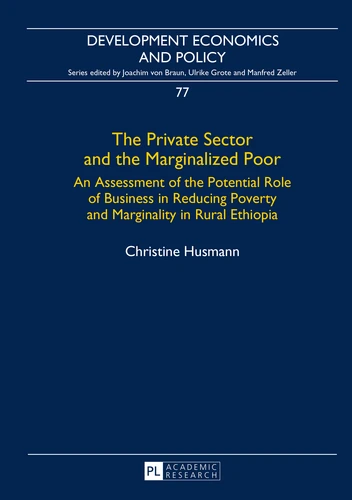
The Private Sector and the Marginalized Poor. An Assessment of the Potential Role of Business in Reducing Poverty and Marginality in Rural Ethiopia
Par :Formats :
- Paiement en ligne :
- Livraison à domicile ou en point Mondial Relay estimée à partir du 2 janvierCet article sera commandé chez un fournisseur et vous sera envoyé 15 jours après la date de votre commande.
- Retrait Click and Collect en magasin gratuit
- Livraison à domicile ou en point Mondial Relay estimée à partir du 2 janvier
- Nombre de pages259
- ISBN978-3-631-67188-7
- EAN9783631671887
- Date de parution01/05/2016
- CollectionDevelopment Economics and Poli
- ÉditeurPeter Lang
Résumé
The book examines the role that the private sector can play in reducing poverty and marginality in Ethiopia by providing improved agricultural inputs to marginalized poor farmers. By creating a marginality map the author analyzes who and where the marginalized poor are. Data from a household survey about purchasing behavior, demand and needs indicates that this group can be a promising market segment for the private sector if adequate business models are applied.
Yet, an analysis of the institutions governing agricultural input markets shows that investments by the private sector are discouraged by de facto monopolies of the government on crucial elements of the different supply chains, including seed breeding, fertilizer imports and finance.
Yet, an analysis of the institutions governing agricultural input markets shows that investments by the private sector are discouraged by de facto monopolies of the government on crucial elements of the different supply chains, including seed breeding, fertilizer imports and finance.
The book examines the role that the private sector can play in reducing poverty and marginality in Ethiopia by providing improved agricultural inputs to marginalized poor farmers. By creating a marginality map the author analyzes who and where the marginalized poor are. Data from a household survey about purchasing behavior, demand and needs indicates that this group can be a promising market segment for the private sector if adequate business models are applied.
Yet, an analysis of the institutions governing agricultural input markets shows that investments by the private sector are discouraged by de facto monopolies of the government on crucial elements of the different supply chains, including seed breeding, fertilizer imports and finance.
Yet, an analysis of the institutions governing agricultural input markets shows that investments by the private sector are discouraged by de facto monopolies of the government on crucial elements of the different supply chains, including seed breeding, fertilizer imports and finance.