SOLDES
Jusqu'à -70% sur une sélection d'articles*

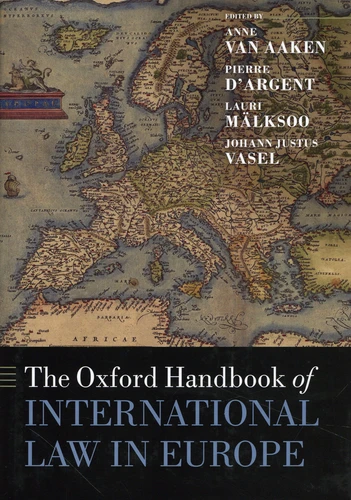
The Oxford Handbook of International Law in Europe
Par : , , ,Formats :
- Paiement en ligne :
- Livraison à domicile ou en point Mondial Relay estimée à partir du 14 janvierCet article sera commandé chez un fournisseur et vous sera envoyé 127 jours après la date de votre commande.
- Retrait Click and Collect en magasin gratuit
- Livraison à domicile ou en point Mondial Relay estimée à partir du 14 janvier
- Réservation en ligne avec paiement en magasin :
- Indisponible pour réserver et payer en magasin
- Nombre de pages915
- FormatGrand Format
- PrésentationRelié
- Poids1.865 kg
- Dimensions17,5 cm × 25,0 cm × 6,0 cm
- ISBN978-0-19-886531-5
- EAN9780198865315
- Date de parution01/03/2025
- CollectionOxford Handbooks
- ÉditeurOxford University Press
- PréfacierLaurence Boisson de Chazournes
Résumé
This handbook provides a comprehensive account of how international law is understood and practised in Europe, which is defined for the purposes of the book as Council of Europe countries, in the past and in the present. It is divided into parts covering Europe's values, intellectual traditions and institutions, as well as the variety of international law traditions and approaches across European countries and regions.
A diverse group of leading scholars and practitioners of international law are led by three overarching foci's points : the success and failures of the pacifying effect of international law, the diversity of international legal experiences and traditions within Europe, and the impact of European ideas on international law globally. By examining these areas, the book also analyses Europe's changing role in the world, and the impact of global.
influences on the understanding of international law in European countries. The book is a study of regionalism in international law, hut also a study of the impact of a region which, at least historically, has had an overwhelming influence on the development and interpretations of international law.
A diverse group of leading scholars and practitioners of international law are led by three overarching foci's points : the success and failures of the pacifying effect of international law, the diversity of international legal experiences and traditions within Europe, and the impact of European ideas on international law globally. By examining these areas, the book also analyses Europe's changing role in the world, and the impact of global.
influences on the understanding of international law in European countries. The book is a study of regionalism in international law, hut also a study of the impact of a region which, at least historically, has had an overwhelming influence on the development and interpretations of international law.