The Authors : Lambros Couloubaritsis, Philosopher, Professor at the Brussels Free University. Marc De Leeuw, Historian, Professor at the St. Stanislas Institute, Brussels. Emile Noël (+), Honorary Secretary-General of the Commission of the European Communities, President of the European Institute in Florence. Claude Sterckx, Course instructor at the Belgian Institute for Higher Studies, Doyen of the Open Facutly for Lay Religions and Humanism.
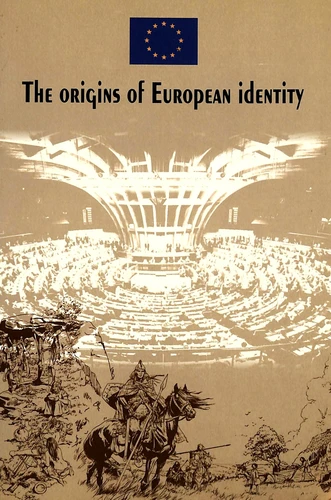
The origins of European identity. Based on an idea by Nicola Bellieni and Salvatore Rossetti
Par : , , ,Formats :
- Nombre de pages187
- PrésentationBroché
- Dimensions14,8 cm × 21,0 cm × 0,0 cm
- ISBN978-90-5201-311-4
- EAN9789052013114
- Date de parution29/04/2013
- CollectionPLG.HUMANITIES
- ÉditeurPeter Lang AG
Résumé
In addition to the Europe of commerce, technology and science which is in the process of gradual formation there is another quite essential Europe - the citizens' Europe - which is something of a poor relation, even though it is a reality which everyone, starting with the politicians, earnestly wishes to see come about. Such a citizens' Europe should form the bricks and mortar of the European Union.
How, then, can we arouse a greater feeling of solidarity and develop that sense of European identity which is so dear to us ? To whom can we turn if not to youth and, therefore, to education ? The Community Institutions have expressed the desire to form Europe through education and to reinforce the European dimension of education. Nevertheless, a huge void needs to be filled in this area and the Europe of education, still at the embryonic stage, has yet to be constructed.
Hence the interest in providing secondary school teachers and students in the twelve countries of the Community with a work aimed primarily at charting a common pool of information on the European identity and encompassing the main thrust of ideas and the essential features of European civilization. In order to reflect current Community policy more faithfully, the book does not set out to replace the curricula taught at the various national schools.
Rather, it is intended to supplement them in the form of a uniform and identical "adjunct" to education, with a view to imparting a better knowledge of and greater love for Europe. The choice of both interlocking subject matters designed to illuminate and guide the editing of this work and the multilingual approach, without which the work would lose part of its purely European aim (the work will be published simultaneously in several different languages), is intended to highlight as far as possible the European ideal and the cultural dimension of Europe, starting with the origins of Europe and tracing Europe's past and present, as well as its prospects for the future.
How, then, can we arouse a greater feeling of solidarity and develop that sense of European identity which is so dear to us ? To whom can we turn if not to youth and, therefore, to education ? The Community Institutions have expressed the desire to form Europe through education and to reinforce the European dimension of education. Nevertheless, a huge void needs to be filled in this area and the Europe of education, still at the embryonic stage, has yet to be constructed.
Hence the interest in providing secondary school teachers and students in the twelve countries of the Community with a work aimed primarily at charting a common pool of information on the European identity and encompassing the main thrust of ideas and the essential features of European civilization. In order to reflect current Community policy more faithfully, the book does not set out to replace the curricula taught at the various national schools.
Rather, it is intended to supplement them in the form of a uniform and identical "adjunct" to education, with a view to imparting a better knowledge of and greater love for Europe. The choice of both interlocking subject matters designed to illuminate and guide the editing of this work and the multilingual approach, without which the work would lose part of its purely European aim (the work will be published simultaneously in several different languages), is intended to highlight as far as possible the European ideal and the cultural dimension of Europe, starting with the origins of Europe and tracing Europe's past and present, as well as its prospects for the future.
A propos de Lambros Couloubaritsis
19,00 €

Position(s) du sujet francophone
Grand Format
22,00 €