
Michael Green is a postdoctoral fellow at the University of Geneva. In 2013, he defended his doctoral dissertation at the University of Groningen. Green's research interests include history of education, nobility studies, friendship and patronage and religious minorities and he has published a number of articles on those subjects.
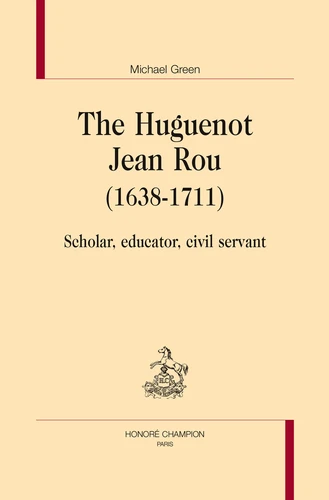
The huguenot Jean Rou (1638-1711). Scholar, educator, civil servant
Par :Formats :
- Nombre de pages480
- PrésentationBroché
- Poids0.8 kg
- Dimensions15,5 cm × 23,5 cm × 0,2 cm
- ISBN978-2-7453-2758-1
- EAN9782745327581
- Date de parution28/05/2015
- ÉditeurHonoré Champion
Résumé
Jean Rou (1638-1711), was a Huguenot scholar, educator and civil servant. Despite having an established career as a lawyer at the Parlement de Paris, he chose instead to dedicate himself to scholarly publications. After being accused of offending the Catholic Church in his Tables de l'histoire universelle moderne (1675) and consequently imprisoned in the Bastille, Rou had to leave France. Initially, he went to England, where he was employed as a tutor.
After a short return to his motherland, where he taught local nobles, he was invited to The Hague, in the United Provinces, to teach the sons of Cornelis van Aerssen van Sommelsdijk, the future governor of Suriname. Finally, in 1689, Jean Rou was appointed as translator of the States-General of the United Provinces, highest position open to a foreigner in this country. Based on his memoirs and extensive archival sources, this book offers a biographical study on Jean Rou.
It focuses on the means by which he established and managed his career in France and abroad. Particular attention is given to Rou's use of networks, friendship and patronage to achieve his goals. The second focus of this study is a comparative examination of Jean Rou's educational ideas and practices, and his position as a man of letters. While Jean Rou was at the centre of this research, this book also offers fascinating insight into the intellectual and social practices of the Huguenots during Rou's lifetime.
This information is presented from two angles that have been rarely discussed before in one context.
After a short return to his motherland, where he taught local nobles, he was invited to The Hague, in the United Provinces, to teach the sons of Cornelis van Aerssen van Sommelsdijk, the future governor of Suriname. Finally, in 1689, Jean Rou was appointed as translator of the States-General of the United Provinces, highest position open to a foreigner in this country. Based on his memoirs and extensive archival sources, this book offers a biographical study on Jean Rou.
It focuses on the means by which he established and managed his career in France and abroad. Particular attention is given to Rou's use of networks, friendship and patronage to achieve his goals. The second focus of this study is a comparative examination of Jean Rou's educational ideas and practices, and his position as a man of letters. While Jean Rou was at the centre of this research, this book also offers fascinating insight into the intellectual and social practices of the Huguenots during Rou's lifetime.
This information is presented from two angles that have been rarely discussed before in one context.
A propos de Michael Green

Blade Runner 2029 T01
E-book
10,99 €

Blade Runner 2019 T03
E-book
10,99 €

Blade Runner 2019 T02
E-book
10,99 €

Blade Runner 2019 T01
E-book
10,99 €

7,99 €

3,99 €

16,50 €

16,50 €

16,50 €