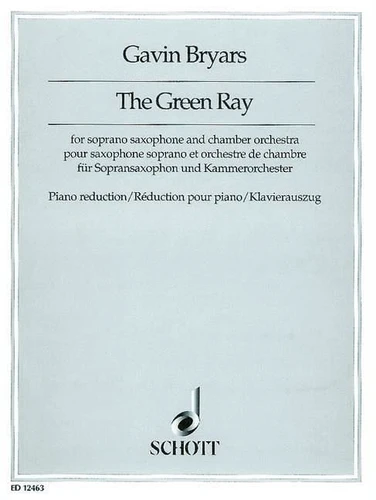
The piece is dedicated to John Harle and the Bournemouth Sinfonietta, who commissioned it with funds made available by South West Arts. It makes use of the saxophone's ability to play long expressive melodic passages, and was written too, having seen the Sinfonietta perform, with some of its individual players in mind. Although played without a break, the piece does fall into a number of recognisable sections delineated by a change of tempo, or by a substantial shift of texture.
For example, shortly before the end, there is a passage where the saxophone is accompanied by 21 solo strings - the entire string section playing divisi, followed by a coda, which contains simultaneous "laments" (for saxophone, cor anglais, French horn, and solo violin). The Green Ray is the title of a romantic novel by Jules Verne, set in the West of Scotland, in which a peculiar atmospheric phenomenon plays the key part.
A "green ray" is seen at sunset in certain latitudes, and in certain coastal conditions, just as the sun touches the horizon and, for a brief moment, the orange sun emits a green ray of light. In the Verne story the simultaneous sighting of the ray will seal a couple's love, and the attempts of a young man to do this are constantly frustrated (by sudden clouds, by a yacht passing along the horizon, and so on).
This part of Western Scotland is also the place where certain piping traditions originated. Male pipers practised in one cave on the seashore, females in another (the "piper's cave" and the "pigeon's cave"). As they played their laments at twilight a triangulation, similar to that in the Verne story (male-ray-female) may well have occurred without the knowledge of the innocent participants, hence the sequence of simultaneous laments in the coda.
On one occasion I witnessed the green ray in Southern California. I was returning along the coast after having climbed up Mt. Tecate, on the top of which is a house, now empty, where Evans-Wentz translated The Tibetan Book of the Dead. Gavin Bryars. Instrumentation : soprano saxophone and chamber orchestra
The piece is dedicated to John Harle and the Bournemouth Sinfonietta, who commissioned it with funds made available by South West Arts. It makes use of the saxophone's ability to play long expressive melodic passages, and was written too, having seen the Sinfonietta perform, with some of its individual players in mind. Although played without a break, the piece does fall into a number of recognisable sections delineated by a change of tempo, or by a substantial shift of texture.
For example, shortly before the end, there is a passage where the saxophone is accompanied by 21 solo strings - the entire string section playing divisi, followed by a coda, which contains simultaneous "laments" (for saxophone, cor anglais, French horn, and solo violin). The Green Ray is the title of a romantic novel by Jules Verne, set in the West of Scotland, in which a peculiar atmospheric phenomenon plays the key part.
A "green ray" is seen at sunset in certain latitudes, and in certain coastal conditions, just as the sun touches the horizon and, for a brief moment, the orange sun emits a green ray of light. In the Verne story the simultaneous sighting of the ray will seal a couple's love, and the attempts of a young man to do this are constantly frustrated (by sudden clouds, by a yacht passing along the horizon, and so on).
This part of Western Scotland is also the place where certain piping traditions originated. Male pipers practised in one cave on the seashore, females in another (the "piper's cave" and the "pigeon's cave"). As they played their laments at twilight a triangulation, similar to that in the Verne story (male-ray-female) may well have occurred without the knowledge of the innocent participants, hence the sequence of simultaneous laments in the coda.
On one occasion I witnessed the green ray in Southern California. I was returning along the coast after having climbed up Mt. Tecate, on the top of which is a house, now empty, where Evans-Wentz translated The Tibetan Book of the Dead. Gavin Bryars. Instrumentation : soprano saxophone and chamber orchestra