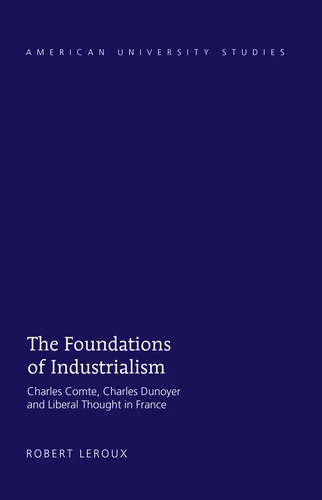
From its beginnings, the doctrine of industrialism has inspired writers of varying persuasions. Saint-Simon is often closely associated with it, however, he represents only the socialist variant of the doctrine. By contrast, the variant that relates to liberalism has been virtually overlooked. Jean-Baptiste Say, Benjamin Constant and Joseph Droz, for example, provided crucial elements that would eventually lead two friends, Charles Comte (1782–1837) and Charles Dunoyer (1786–1862), to define industrialism in a more complete manner that was in fact radically opposed in many aspects to the notions of Saint-Simon.
This shows that the term "industrialism" has many meanings. Mechanization, the production of wealth, the age of trades and specialization, the notion that progress is unstoppable, the question of liberty and individualism – these are the main themes that we find in the writings of the liberal proponents of industrialism. For Charles Comte and Charles Dunoyer, industrialism was a kind of philosophy of history, the purpose of which was to identify the tortuous stages through which the idea of liberty had developed.
In doing this, as Robert Leroux explains, they shared a conviction, or perhaps a concern, based on clear historical evidence, that liberty is a fragile thing, and that its victory will never be final.
From its beginnings, the doctrine of industrialism has inspired writers of varying persuasions. Saint-Simon is often closely associated with it, however, he represents only the socialist variant of the doctrine. By contrast, the variant that relates to liberalism has been virtually overlooked. Jean-Baptiste Say, Benjamin Constant and Joseph Droz, for example, provided crucial elements that would eventually lead two friends, Charles Comte (1782–1837) and Charles Dunoyer (1786–1862), to define industrialism in a more complete manner that was in fact radically opposed in many aspects to the notions of Saint-Simon.
This shows that the term "industrialism" has many meanings. Mechanization, the production of wealth, the age of trades and specialization, the notion that progress is unstoppable, the question of liberty and individualism – these are the main themes that we find in the writings of the liberal proponents of industrialism. For Charles Comte and Charles Dunoyer, industrialism was a kind of philosophy of history, the purpose of which was to identify the tortuous stages through which the idea of liberty had developed.
In doing this, as Robert Leroux explains, they shared a conviction, or perhaps a concern, based on clear historical evidence, that liberty is a fragile thing, and that its victory will never be final.