Jeffrey Pfefer is the Thomas D. Dee II Professor of Organizational Behavior at the Stanford Graduate School of Business. His recent publications include The Knowing-Doing Gap : How Smart Companies Turn Knowledge into Action and Hidden Value : How Great Companies Achieve Extraordinary Results with Ordinary People. Gerald R. Salancik mass the D. B. Kirr Professor of Organization at the Graduate School of Industrial Administration at Carnegie Mellon University.
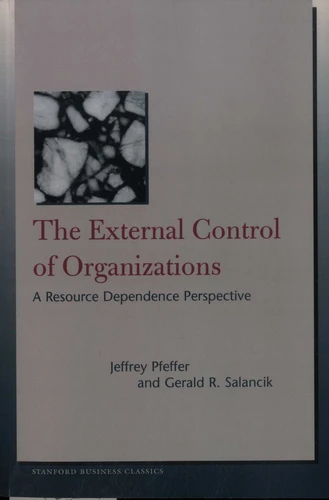
The External Control of Organizations. A Resource Dependence Perspective
Par : ,Formats :
- Paiement en ligne :
- Livraison à domicile ou en point Mondial Relay estimée à partir du 28 septembreCet article sera commandé chez un fournisseur et vous sera envoyé 25 jours après la date de votre commande.
- Retrait Click and Collect en magasin gratuit
- Nombre de pages300
- FormatGrand Format
- PrésentationBroché
- Poids0.505 kg
- Dimensions15,7 cm × 23,3 cm × 2,2 cm
- ISBN0-8047-4789-X
- EAN9780804747899
- Date de parution01/03/2003
- CollectionBusiness Classics
- ÉditeurStanford University Press
Résumé
Among the most widely cited books in the social sciences, The External Control of Organizations has long been required reading for any student of organization studies. The book, reissued on its 25th anniversary as part of the Stanford Business Classics series, includes a new preface written by Jeffrey Pfeffer, which examines the legacy of this influential work in current research and its relationship to other theories.
The External Control of Organizations explores how external constraints affect organizations and provides insights for designing and managing organizations to mitigate these constraints. All organizations are dependent on the environment for their survival. As the authors contend, "it is the fact of the organization's dependence on the environment that makes the external constraint and control of organizational behavior both possible and almost inevitable." Organizations can either try to change their environments through political means or form interorganizational relationships to control or absorb uncertainty.
This seminal book established the resource dependence approach that has informed so many other important organization theories.
The External Control of Organizations explores how external constraints affect organizations and provides insights for designing and managing organizations to mitigate these constraints. All organizations are dependent on the environment for their survival. As the authors contend, "it is the fact of the organization's dependence on the environment that makes the external constraint and control of organizational behavior both possible and almost inevitable." Organizations can either try to change their environments through political means or form interorganizational relationships to control or absorb uncertainty.
This seminal book established the resource dependence approach that has informed so many other important organization theories.