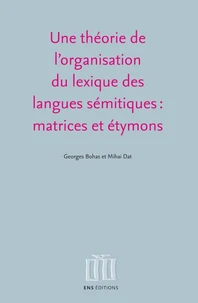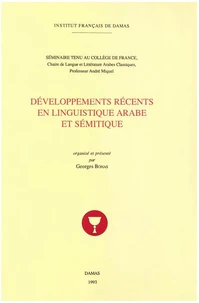
Georges Bohas est professeur l'ENS Lettres et Sciences humaines (Lyon), spcialiste de linguistique et de potique arabes et syriaques.
SOLDES
Jusqu'à -70% sur une sélection d'articles*
The Explanation of Homonymy in the Lexicon of Arabic
Par : ,Formats :
- Paiement en ligne :
- Livraison à domicile ou en point Mondial Relay estimée à partir du 20 novembreCet article sera commandé chez un fournisseur et vous sera envoyé 127 jours après la date de votre commande.
- Retrait Click and Collect en magasin gratuit
- Livraison à domicile ou en point Mondial Relay estimée à partir du 20 novembre
- Réservation en ligne avec paiement en magasin :
- Indisponible pour réserver et payer en magasin
- Nombre de pages189
- PrésentationBroché
- Poids0.32 kg
- Dimensions15,0 cm × 22,8 cm × 1,2 cm
- ISBN978-2-84788-408-1
- EAN9782847884081
- Date de parution24/11/2014
- CollectionLangages
- ÉditeurENS (Editions)
Résumé
The phenomenon of homonymy appeared at the conceptual beginnings of Arabic grammar. In the chapter devoted to the relationship between form and lexical meaning in the kitâb by Sîbawayhi we read that it is possible to find in the spoken language of the Arabs "two concordant forms although the meanings differ, when you say : wajadtu ? alayhi (I felt resentment against him), which comes from al-mawjidatu (resentment) and wajgadtu (I found) if you look at wijdana l-? allati (to find the lost animal).
Examples of this kind are numerous". Throughout the centuries nobody has been able to provide a satisfactory explanation of this phenomenon. Standard linguistic studies restrict themselves to the level of the root, whereas this phenomenon can only be accounted for at the submorphemic level. As posited in the Theory of Etymons and Matrices (TME), the minimal phonetic units of the lexicon are not phonemes but phonetic features and the minimal units of sound and meaning are not morphemes but matrices composed of vectors of phonetic features correlated to a notional invariant.
In this book we account for some fifty roots (in the traditional meaning of the term). Such a large number cannot be dismissed as just a handful of convenient examples chosen for the purpose. Within the framework of TME, homonymy is thus an ordinary phenomenon which is predicted and explained by the theory and every case of homonymy will have an explanation once the entire lexicon has been described.
Examples of this kind are numerous". Throughout the centuries nobody has been able to provide a satisfactory explanation of this phenomenon. Standard linguistic studies restrict themselves to the level of the root, whereas this phenomenon can only be accounted for at the submorphemic level. As posited in the Theory of Etymons and Matrices (TME), the minimal phonetic units of the lexicon are not phonemes but phonetic features and the minimal units of sound and meaning are not morphemes but matrices composed of vectors of phonetic features correlated to a notional invariant.
In this book we account for some fifty roots (in the traditional meaning of the term). Such a large number cannot be dismissed as just a handful of convenient examples chosen for the purpose. Within the framework of TME, homonymy is thus an ordinary phenomenon which is predicted and explained by the theory and every case of homonymy will have an explanation once the entire lexicon has been described.