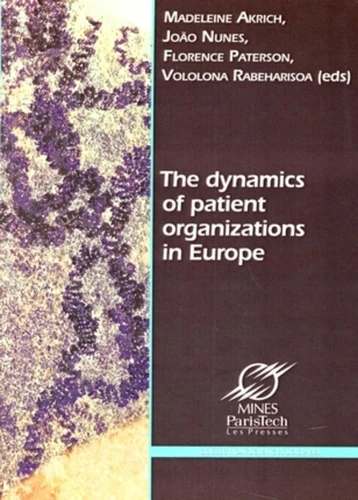
Patient organizations today play a major role in the scientific, economic and political arenas. They have become the quasi-obliged partners of researchers, industrialists and political authorities. This book investigates this quite recent configuration by offering an in-depth exploration of three thematic issues : To what social and political stakes are patient organizations confronted as regards the transformation, production, circulation, and governance of knowledge ? The involvement of patient organizations in the economic world is acknowledged as confrontational, especially when it comes to relationships with the pharmaceutical industry.
To what extent do opposition, "instrumentalization", or cooperation constitute relevant models if we are to account for the multifaceted relationships between patient organizations and economic actors ? Patient organisations are the structuring actors of networks, coalitions, and collectives throughout Europe. What social and political concerns arise from these particular forms of collective action on a national or European scale ? Each question is first examined through an academic and grey literature review.
Then the emerging topics and critical issues are identified and discussed, drawing upon exchanges of experiences, viewpoints, and reflections between actors involved in patients' and users' movements and social scientists. The dynamics of patient organizations in Europe raises a number of questions of interest for all actors from the health system, as well as for social scientists. This book intends to contribute to the reflection on further research agenda setting and policy-making.
Patient organizations today play a major role in the scientific, economic and political arenas. They have become the quasi-obliged partners of researchers, industrialists and political authorities. This book investigates this quite recent configuration by offering an in-depth exploration of three thematic issues : To what social and political stakes are patient organizations confronted as regards the transformation, production, circulation, and governance of knowledge ? The involvement of patient organizations in the economic world is acknowledged as confrontational, especially when it comes to relationships with the pharmaceutical industry.
To what extent do opposition, "instrumentalization", or cooperation constitute relevant models if we are to account for the multifaceted relationships between patient organizations and economic actors ? Patient organisations are the structuring actors of networks, coalitions, and collectives throughout Europe. What social and political concerns arise from these particular forms of collective action on a national or European scale ? Each question is first examined through an academic and grey literature review.
Then the emerging topics and critical issues are identified and discussed, drawing upon exchanges of experiences, viewpoints, and reflections between actors involved in patients' and users' movements and social scientists. The dynamics of patient organizations in Europe raises a number of questions of interest for all actors from the health system, as well as for social scientists. This book intends to contribute to the reflection on further research agenda setting and policy-making.