

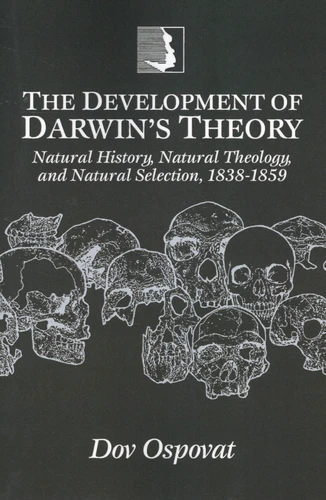
The development of Darwin's theory. Natural history, natural theology, and natural selection, 1838-1859
Par :Formats :
- Nombre de pages301
- FormatGrand Format
- PrésentationBroché
- Poids0.53 kg
- Dimensions15,2 cm × 22,8 cm × 3,0 cm
- ISBN0-521-46940-6
- EAN9780521469401
- Date de parution01/04/1995
- ÉditeurCambridge University Press
- PréfacierAdrian Desmond
Résumé
Dov Ospovat's book, originally published in 1981, has become generally accepted as one of the most influential books about Darwin published in recent years. The period examined is that between 1838, by which time Darwin had formulated his theory of evolution by natural selection, and 1859, when the Origin of Species was published. Ospovat examines this period in detail and shows that Darwin's views changed quite radically from initially believing that animals and plants were perfectly adapted to their environments, and that evolution only occurred when the environment changed, to believing that living things were not perfectly adapted, were in constant competition with each other, and hence were continually evolving.
Ospovat's was the first study to show conclusively that Darwin's theory changed during this period and that he altered his opinion due to ideas and developments occurring elsewhere in the biology of his time. By placing Darwin within the other biological developments of the day, he is able to show that Darwin was not the scientific recluse of popular myth, that there was a theological basis for much of Darwin's original 1838-1844 theory, and that his later "principle of divergence" was influenced by his belief in evolutionary progress.
Ospovat's was the first study to show conclusively that Darwin's theory changed during this period and that he altered his opinion due to ideas and developments occurring elsewhere in the biology of his time. By placing Darwin within the other biological developments of the day, he is able to show that Darwin was not the scientific recluse of popular myth, that there was a theological basis for much of Darwin's original 1838-1844 theory, and that his later "principle of divergence" was influenced by his belief in evolutionary progress.