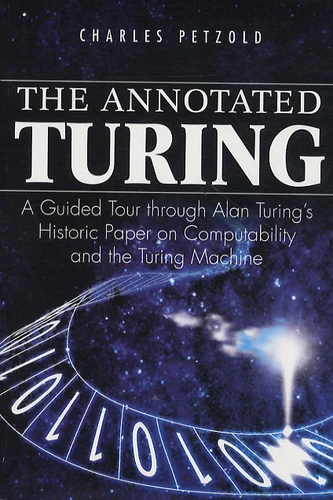
Before digital computers ever existed, Alan Turing envisioned their power and versatility... but also proved what computers could never do. In an extraordinary and ultimately tragiclife that unfolded like a novel, Turing helped break the German Enigma code to turn the tide of World War II, later speculated on artificial intelligence, fell victim to the homophobic witchhunts of the early 1950s, and committed suicide at the age of 41.
Yet Turing is most famous for an eerily prescient 1936 paper in which he invented an imaginary computing machine, explored its capabilities and intrinsic limitations, and established the foundations of modem-day programming and computability. This absorbing book expands Turing's now legendary 36-page paper with extensive annotations, fascinating historical context, and page-turning glimpses into his private life.
From his use of binary numbers to his exploration of concepts that today's programmers will recognize as RISC processing, subroutines,' algorithms, and others, Turing foresaw the future and helped to mold it. In our post-Turing world, everything is a Turing Machine — from the most sophisticated computers we can build, to the hardly algorithmic processes of the human mind, to the informhtion-laden universe in which we live.
Before digital computers ever existed, Alan Turing envisioned their power and versatility... but also proved what computers could never do. In an extraordinary and ultimately tragiclife that unfolded like a novel, Turing helped break the German Enigma code to turn the tide of World War II, later speculated on artificial intelligence, fell victim to the homophobic witchhunts of the early 1950s, and committed suicide at the age of 41.
Yet Turing is most famous for an eerily prescient 1936 paper in which he invented an imaginary computing machine, explored its capabilities and intrinsic limitations, and established the foundations of modem-day programming and computability. This absorbing book expands Turing's now legendary 36-page paper with extensive annotations, fascinating historical context, and page-turning glimpses into his private life.
From his use of binary numbers to his exploration of concepts that today's programmers will recognize as RISC processing, subroutines,' algorithms, and others, Turing foresaw the future and helped to mold it. In our post-Turing world, everything is a Turing Machine — from the most sophisticated computers we can build, to the hardly algorithmic processes of the human mind, to the informhtion-laden universe in which we live.