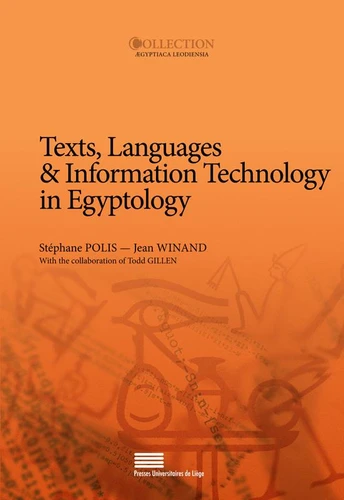
This volume represents the outcome of the meeting of the Computer Working Group of the International Association of Egyptologists (Informatique & Egyptologie) held in Liège in 2010 (6-8 July) under the auspices of the Ramses Project. The papers are based on presentations given during this meeting and have been selected in order to cover three main thematic areas of research at the intersection of Egyptology and Information Technology : (1) the construction, management and use of Ancient Egyptian annotated corpora ; (2) the problems linked to hieroglyphic encoding ; (3) the development of databases in the fields of art history, philology and prosopography.
The contributions offer an up-to-date state of the art, discuss the most promising avenues for future research, developments and implementation, and suggest solutions to longstanding issues in the field. Two general trends characterize the projects laid out here : the desire for online accessibility made available to the widest possible audience ; and the search for standardization and interoperability.
The efforts in these directions are admittedly of paramount importance for the future of Egyptological research in general. Indeed, for the present and increasingly for the future, one cannot overemphasize the (empirical and methodological) impact of a generalized access to structured data of the highest possible quality that can be browsed and exchanged without loss of information.
This volume represents the outcome of the meeting of the Computer Working Group of the International Association of Egyptologists (Informatique & Egyptologie) held in Liège in 2010 (6-8 July) under the auspices of the Ramses Project. The papers are based on presentations given during this meeting and have been selected in order to cover three main thematic areas of research at the intersection of Egyptology and Information Technology : (1) the construction, management and use of Ancient Egyptian annotated corpora ; (2) the problems linked to hieroglyphic encoding ; (3) the development of databases in the fields of art history, philology and prosopography.
The contributions offer an up-to-date state of the art, discuss the most promising avenues for future research, developments and implementation, and suggest solutions to longstanding issues in the field. Two general trends characterize the projects laid out here : the desire for online accessibility made available to the widest possible audience ; and the search for standardization and interoperability.
The efforts in these directions are admittedly of paramount importance for the future of Egyptological research in general. Indeed, for the present and increasingly for the future, one cannot overemphasize the (empirical and methodological) impact of a generalized access to structured data of the highest possible quality that can be browsed and exchanged without loss of information.