

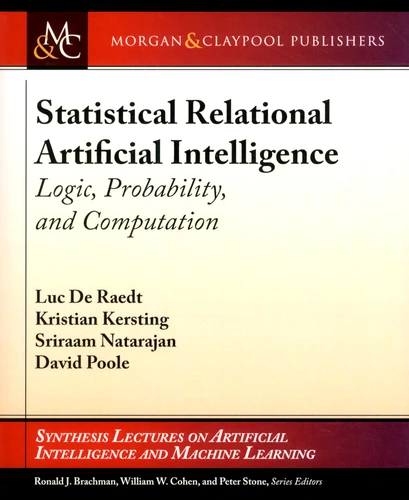
Statistical Relational Artificial Intelligence. Logic, Probability, and Computation
Par : , , ,Formats :
- Nombre de pages175
- FormatGrand Format
- PrésentationBroché
- Poids0.34 kg
- Dimensions18,7 cm × 23,3 cm × 1,5 cm
- ISBN978-1-62705-841-4
- EAN9781627058414
- Date de parution24/03/2016
- CollectionSynthesis Lectures on Artifici
- ÉditeurMorgan & Claypool
Résumé
An intelligent agent interacting with the real world will encounter individual people, courses, test results, drugs prescriptions, chairs, boxes, etc., and needs to reason about properties of these individuals and relations among them as well as cope with uncertainty. Uncertainty has been studied in probability theory and graphical models, and relations have been studied in logic, in particular in the predicate calculus and its extensions.
This book examines the foundations of combining logic and probability into what are called relational probabilistic models. It introduces representations, inference, and learning techniques for probability, logic, and their combinations. The book focuses on two representations in detail : Markov logic networks, a relational extension of undirected graphical models and weighted first-order predicate calculus formula, and Problog, a probabilistic extension of logic programs that can also be viewed as a Turing-complete relational extension of Bayesian networks.
This book examines the foundations of combining logic and probability into what are called relational probabilistic models. It introduces representations, inference, and learning techniques for probability, logic, and their combinations. The book focuses on two representations in detail : Markov logic networks, a relational extension of undirected graphical models and weighted first-order predicate calculus formula, and Problog, a probabilistic extension of logic programs that can also be viewed as a Turing-complete relational extension of Bayesian networks.
L'éditeur en parle
This volume is a printed version of a work that appears in the Synthesis Digital Library of Engineering and Computer Science. Synthesis books provide concise, original presentations of important research and development topics, published quickly, in digital and print formats.