
The Author : Claire Omhovère is a Professor of English at University Nancy 2 (France). After writing a Ph.D. on the novels of Robert Kroetsch, she has specialized in postcolonial studies with a particular interest in the perception of space and the representation of landscape in Canadian culture. She has published articles in European and Canadian journals and contributed book chapters on the writings of Alistair MacLeod, Suzette Mayr, Rudy Wiebe and Jane Urquhart.
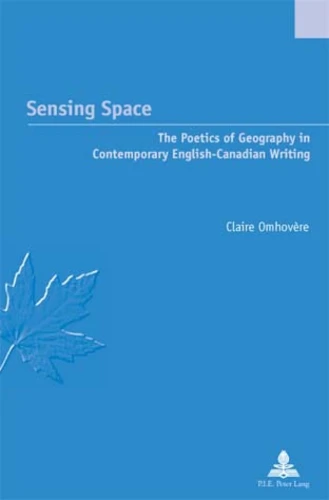
Sensing Space. The Poetics of Geography in Contemporary English-Canadian Writing
Par :Formats :
- Nombre de pages186
- PrésentationBroché
- Dimensions22,0 cm × 15,0 cm × 0,0 cm
- ISBN90-5201-053-6
- EAN9789052010533
- Date de parution01/12/1998
- CollectionPLG.HUMANITIES
- ÉditeurPeter Lang AG
Résumé
This book enlarges the perspective of literary geography which tends to focus on the correspondence between the objective world the geographer addresses and its subjective rendering in art. Instead it considers how geography informs fresh aesthetic responses to space in contemporary Canadian literature, with specific attention to the writings of Alistair MacLeod, Jane Urquhart, Anne Michaels, Aritha van Herk, Rudy Wiebe, Robert Kroetsch and Thomas Wharton.
This broadening leads to a series of interrogations : what blanks in conventional landscape writing does physical geography fill, and how ? Where does the efficiency of geography lie beyond its scientific accuracy or descriptive relevance ? Pondering the role of geography in a work of art therefore amounts to considering what makes geography work as art – is there such a thing as a poetics of geography ? Because the place of the writer and the representation of space remain two central concerns in Canadian writing, the texts under scrutiny help elucidate the critical role performed by the "geographical imagination," a phrase used by theoreticians as diverse as Edward Said, Edward Soja or Derek Gregory, in the fabrication of symbolic ties between Canadians and the land they have come to share.
This broadening leads to a series of interrogations : what blanks in conventional landscape writing does physical geography fill, and how ? Where does the efficiency of geography lie beyond its scientific accuracy or descriptive relevance ? Pondering the role of geography in a work of art therefore amounts to considering what makes geography work as art – is there such a thing as a poetics of geography ? Because the place of the writer and the representation of space remain two central concerns in Canadian writing, the texts under scrutiny help elucidate the critical role performed by the "geographical imagination," a phrase used by theoreticians as diverse as Edward Said, Edward Soja or Derek Gregory, in the fabrication of symbolic ties between Canadians and the land they have come to share.