
The Author : Celestine Woo is Assistant Professor of English at SUNY Empire State College in Hartsdale, New York, where she teaches Shakespeare, British literature, and writing. She received her Ph.D. from New York University. She has published poetry as well as articles on Shakespeare, Sarah Siddons, Asian American literature, and children's literature.
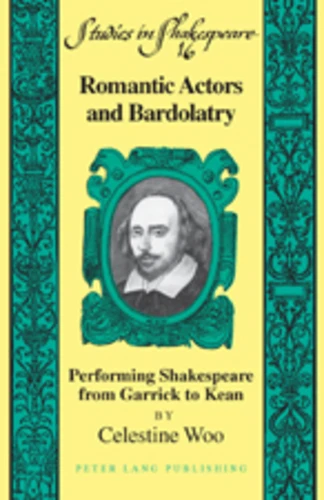
Romantic Actors and Bardolatry. Performing Shakespeare from Garrick to Kean
Par :Formats :
- Paiement en ligne :
- Livraison à domicile ou en point Mondial Relay estimée à partir du 14 octobreCet article sera commandé chez un fournisseur et vous sera envoyé 25 jours après la date de votre commande.
- Retrait Click and Collect en magasin gratuit
- Nombre de pages209
- ISBN978-1-4331-0163-2
- EAN9781433101632
- Date de parution01/07/2008
- CollectionStudies in Shakespeare
- ÉditeurPeter Lang
Résumé
"Bardolatry", that whimsical term referring to Shakespeare's rise to canonical status as well as to his worshippers' adulation, solidified within the theatrical discourses of the eighteenth century and the British Romantic era. Celestine Woo examines the era's four most celebrated Shakespeare performers in London – David Garrick, John Philip Kemble, Sarah Siddons, and Edmund Kean – arguing that they broadened and altered the boundaries of Shakespearean discourse in specific ways, offering and modeling novel paradigms by which to apprehend Shakespeare, and thus contributing to the growth of bardolatry as a discursive phenomenon.
Using Pierre Bourdieu as a model, Woo traces the development of Shakespearean discourse as a field of cultural production, shaped by these actors. By examining their disparate approaches to performing Shakespeare, she reveals that Shakespeare as an icon became commodified, politicized, gendered, and increasingly appropriated within literary and dramatic discourse as a result of the influences of these four performers.
Her analysis deepens our understanding of the processes by which Shakespeare was institutionalized as a figure representing national character, human nature, and the breadth of human experience.
Using Pierre Bourdieu as a model, Woo traces the development of Shakespearean discourse as a field of cultural production, shaped by these actors. By examining their disparate approaches to performing Shakespeare, she reveals that Shakespeare as an icon became commodified, politicized, gendered, and increasingly appropriated within literary and dramatic discourse as a result of the influences of these four performers.
Her analysis deepens our understanding of the processes by which Shakespeare was institutionalized as a figure representing national character, human nature, and the breadth of human experience.