SOLDES

Jusqu'à -70% sur une sélection d'articles*

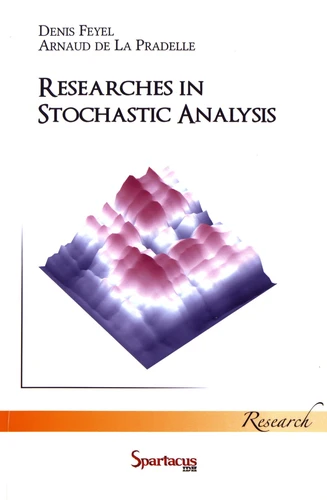
Researches in Stochastic Analysis

Par : Denis Feyel, Arnaud de La Pradelle
Nous vous prions de nous excuser mais rencontrons momentanément des soucis d'approvisionnement. C’est le moment de vous laisser tenter par nos livres numériques et notre offre occasion.
  • Paiement en ligne :
    • Livraison à domicile ou en point Mondial Relay estimée à partir du 4 novembre
      Cet article sera commandé chez un fournisseur et vous sera envoyé 127 jours après la date de votre commande.
    • Retrait Click and Collect en magasin gratuit
  • Réservation en ligne avec paiement en magasin :
    • Indisponible pour réserver et payer en magasin
  • Nombre de pages148
  • FormatGrand Format
  • PrésentationBroché
  • Poids0.445 kg
  • Dimensions16,0 cm × 24,0 cm × 1,0 cm
  • ISBN978-2-36693-026-9
  • EAN9782366930269
  • Date de parution01/03/2017
  • CollectionSpartacus Research
  • ÉditeurSpartacus IDH

Résumé

Fundamentally this book presents an analytic point of view on the probability theory of processes and emphasizes the strong connections between classical Potential Theory and Brownian motion. Since well-known superharmonic functions and supermartingales are so closely related that the filtering theory of processes can be seen as a particular Potential theory, they are analyzed here by the use of a common framework.
This framework is the space L1(c) where c is a capacity, that is, roughly speaking, a sublinear functional, as first considered by B. Fuglede. An associated notion of quasi-topology is defined that gives a very good account of the classical quasi-continuous functions in the finite or the infinite dimensional case of the Malliavin calculus on a Wiener space. Methods and definitions differ from the usual ones.
The white noise calculus of T. Hida is also considered. The existence of the Hausdorff measure of finite codi-mension on the Wiener space is established with the corresponding Federer coarea formula. Two chapters are devoted to the determinist calculus initiated by T. Lyons. It is based on a "sewing lemma" which leads to an easy proof of the existence and uniqueness of the solution of a differential equation driven by a-Holder signal greater than 1/3.
This book concerns mathematicians who use stochastic methods in their research. It should also be of interest to students having some notions of functional analysis and of probability theory or at least of measure theory.