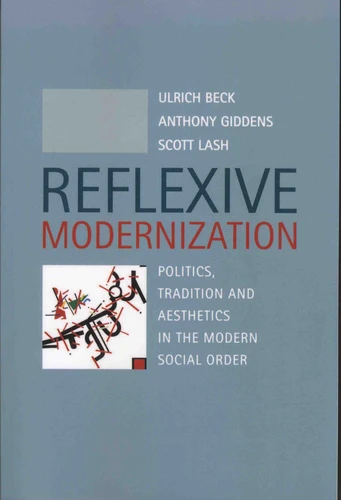
Ulrich Beck is Professor of Sociology at the University of Munich. Anthony Giddens is Professor of Sociology at the University of Cambridge. Scott Lash is Professor of Sociology at the University of Lancaster.
Reflexive Modernization. Politics, Tradition and Aesthetics in the Modern Social Order
Par : , ,Formats :
- Nombre de pages225
- FormatGrand Format
- PrésentationBroché
- Poids0.335 kg
- Dimensions15,3 cm × 22,7 cm × 1,3 cm
- ISBN0-8047-2472-5
- EAN9780804724722
- Date de parution01/10/1994
- ÉditeurStanford University Press
Résumé
The theme of reflexivity has come to be central to social analysis. In this book three prominent social thinkers discuss the implications of "reflexive modernization" for social and cultural theory today. Ulrich Beck's vision of the "risk society" has already become extraordinarily influential. Beck offers a new elaboration of his basic ideas, connecting reflexive modernization with new issues to do with the state and political organization.
Giddens offers an in-depth examination of the connections between "institutional reflexivity" and the de-traditionalizing of the modern world. We are entering, he argues, a phase of the development of a global society. A "global society" is nota world society, but one with universalizing tendencies. Lash develops the theme of reflexive modernization in relation to aesthetics and the interpretation of culture.
In this domain, he suggests, we need to look again at the conventional theories of postmodernism ; "aesthetic modernization" has distinctive qualities that need to be uncovered and analyzed. In the concluding sections of the book, the three authors offer critical appraisals of each other's viewpoints, providing a synthetic conclusion to the work as a whole.
Giddens offers an in-depth examination of the connections between "institutional reflexivity" and the de-traditionalizing of the modern world. We are entering, he argues, a phase of the development of a global society. A "global society" is nota world society, but one with universalizing tendencies. Lash develops the theme of reflexive modernization in relation to aesthetics and the interpretation of culture.
In this domain, he suggests, we need to look again at the conventional theories of postmodernism ; "aesthetic modernization" has distinctive qualities that need to be uncovered and analyzed. In the concluding sections of the book, the three authors offer critical appraisals of each other's viewpoints, providing a synthetic conclusion to the work as a whole.
A propos de Ulrich Beck
12,00 €


29,50 €

23,00 €