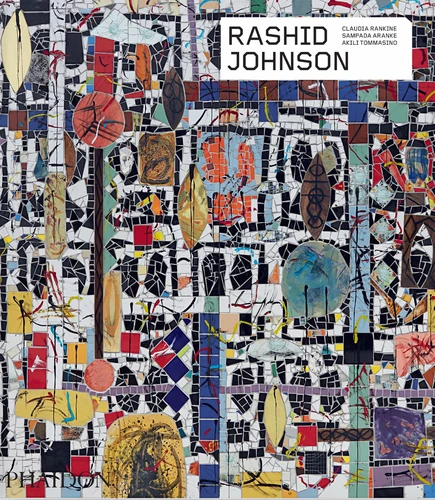
Rashid Johnson is a contemporary American artist known for his investigation of themes such as art and critical history, cultural identity and narrative - both individual and collective - literature, music, philosophy and film. Such explorations are conducted and accomplished through a multifaceted and multidisciplinary practice that incorporates diverse materials rich with symbolism and personal significance.
Some of these are associated with the artist's formative years, and often address aspects of African American experience. These include an array of objects that go from the mundane, CB radios, shea butter and black soap, to the intellectual, book and record covers, CD and videotape cases, and the exotic, gilded rocks and tropical plants. By establishing a direct connection with the creations influential to his process through the use of visual reference points, Johnson de facto becomes a fellow traveller of the people who have inspired him, at once positioning himself within a lineage and perpetuating the legacy of those who came before him while creating something anew.
Rashid Johnson was born in Chicago in 1977. He earned a 2000 Bachelor of Fine Arts from Columbia College Chicago and a 2005 Master of Fine Arts from the School of the Art Institute of Chicago. At age 21, Johnson was one of the youngest artists included in the seminal exhibition "Freestyle" at the Studio Museum in Harlem, 2001. From then on Johnson experienced a successful international career. His work has been exhibited in some of the most prestigious institutions the world over, including the Whitney Museum of American Art, New York, the Metropolitan Museum of Art, New York, the Detroit Institute of Arts, the Walker Art Center, Minneapolis, the Corcoran Museum of Art, Washington, DC, the International Center of Photography, New York, the Brooklyn Museum of Art, New York, and the Museum of Contemporary Art, Chicago.
In 2019 Johnson made his directorial debut with a film adaptation of Richard Wright's 1940 novel Native Son. Johnson lives and works in New York. In the Interview, Claudia Rankine and Johnson discuss the artist's modus operandi and motivations. Akili Tommasino's Survey text recounts the most important episodes of Johnson's career, from the series of photographs exhibited on the occasion of the pivotal exhibition "Freestyle" at the Studio Museum in Harlem in 2001, to his most recent large-scale, immersive installations such as Antoine's Organ, 2015, and Sodade, 2022.
In the Focus, Sampada Aranke examines The Broken Five, a powerful piece Johnson created in 2019 to reflect on the destiny of five young Afro-American men, also known as the Central Park Five, indicted for a crime they never committed. After spending a significant amount of their adult life in prison, the five men were fully acquitted in 2022 - thirty-one years after being accused and three years after Johnson's piece - and became known as "The Exonerated Five".
Some of these are associated with the artist's formative years, and often address aspects of African American experience. These include an array of objects that go from the mundane, CB radios, shea butter and black soap, to the intellectual, book and record covers, CD and videotape cases, and the exotic, gilded rocks and tropical plants. By establishing a direct connection with the creations influential to his process through the use of visual reference points, Johnson de facto becomes a fellow traveller of the people who have inspired him, at once positioning himself within a lineage and perpetuating the legacy of those who came before him while creating something anew.
Rashid Johnson was born in Chicago in 1977. He earned a 2000 Bachelor of Fine Arts from Columbia College Chicago and a 2005 Master of Fine Arts from the School of the Art Institute of Chicago. At age 21, Johnson was one of the youngest artists included in the seminal exhibition "Freestyle" at the Studio Museum in Harlem, 2001. From then on Johnson experienced a successful international career. His work has been exhibited in some of the most prestigious institutions the world over, including the Whitney Museum of American Art, New York, the Metropolitan Museum of Art, New York, the Detroit Institute of Arts, the Walker Art Center, Minneapolis, the Corcoran Museum of Art, Washington, DC, the International Center of Photography, New York, the Brooklyn Museum of Art, New York, and the Museum of Contemporary Art, Chicago.
In 2019 Johnson made his directorial debut with a film adaptation of Richard Wright's 1940 novel Native Son. Johnson lives and works in New York. In the Interview, Claudia Rankine and Johnson discuss the artist's modus operandi and motivations. Akili Tommasino's Survey text recounts the most important episodes of Johnson's career, from the series of photographs exhibited on the occasion of the pivotal exhibition "Freestyle" at the Studio Museum in Harlem in 2001, to his most recent large-scale, immersive installations such as Antoine's Organ, 2015, and Sodade, 2022.
In the Focus, Sampada Aranke examines The Broken Five, a powerful piece Johnson created in 2019 to reflect on the destiny of five young Afro-American men, also known as the Central Park Five, indicted for a crime they never committed. After spending a significant amount of their adult life in prison, the five men were fully acquitted in 2022 - thirty-one years after being accused and three years after Johnson's piece - and became known as "The Exonerated Five".