

Paul Hullmeine is a historian of philosophy and science. His research focuses on Greek natural philosophy and astronomy and its reception in the Arabic Middle Ages. He received his PhD from the LMU Munich and currently holds a postdoctoral position at the same university, funded by the DFG.
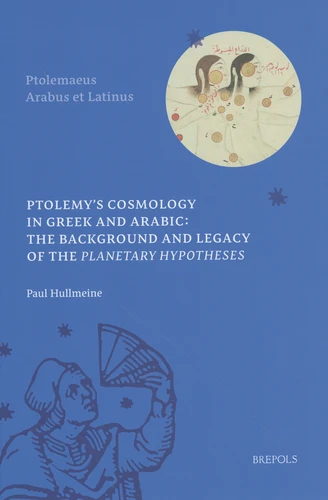
Ptolemy's Cosmology in Greek and Arabic. The Background and Legacy of the Planetary Hypotheses
Par :Formats :
- Nombre de pages480
- FormatGrand Format
- PrésentationRelié
- Poids1.17 kg
- Dimensions18,0 cm × 26,0 cm × 3,0 cm
- ISBN978-2-503-60717-7
- EAN9782503607177
- Date de parution01/01/2024
- CollectionPtolemaeus Arabus et Latinus
- ÉditeurBrepols
Résumé
Ptolemy's Almagest (2nd century AD) is the most influential work of ancient and medieval astronomy. This work, however, does not tell us the full story about its author's views of the heavens. After completing the Almagest, Ptolemy turned his attention to a physical investigation of celestial motions. The result is the Planetary Hypotheses, a bold attempt to provide a celestial physics that coheres with the mathematical account of astronomical observations in his Almagent.
This book provides the first complete critical edition and English translation of the Arabic version of the Planetary Hypotheses, which is lost for the most part in its original Greek. It furthermore provides an extensive commentary on the whole work, which situates the Planetary Hypotheses within the context of its time and investigates philosophical ideas central to the work. These include the epistemic value of mathematics relative to natural philosophy, and the shape, number, and dynamics of the celestial bodies.
The book also investigates the influence of the Planetary Hypotheses on a wide range of medieval Arabic astronomical and philosophical works from the 9th to the 13th century AD. The upshot is to establish the Planetary Hypotheses as a crucial text for understanding the history of philosophy and science from Greek antiquity to the Arabic Middle Ages.
This book provides the first complete critical edition and English translation of the Arabic version of the Planetary Hypotheses, which is lost for the most part in its original Greek. It furthermore provides an extensive commentary on the whole work, which situates the Planetary Hypotheses within the context of its time and investigates philosophical ideas central to the work. These include the epistemic value of mathematics relative to natural philosophy, and the shape, number, and dynamics of the celestial bodies.
The book also investigates the influence of the Planetary Hypotheses on a wide range of medieval Arabic astronomical and philosophical works from the 9th to the 13th century AD. The upshot is to establish the Planetary Hypotheses as a crucial text for understanding the history of philosophy and science from Greek antiquity to the Arabic Middle Ages.