

Olga Zeydina, PhD in Probabilistic Methods for Nuclear Safety, has been Research Engineer at the Société de Calcul Mathématique SA, since 2006. Bernard Beauzamy, University Professor (1979-1995), founded SCM SA in 1995 and since then has been Chairman of this company.
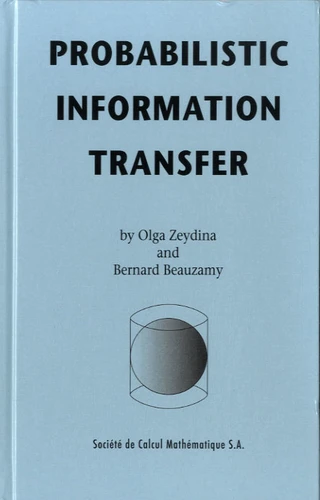
Probabilistic Information Transfer
Par : ,Formats :
- Nombre de pages208
- FormatGrand Format
- PrésentationRelié
- Poids0.45 kg
- Dimensions16,0 cm × 24,7 cm × 1,4 cm
- ISBN978-2-9521458-6-2
- EAN9782952145862
- Date de parution02/04/2013
- CollectionReal Life Mathematics
- ÉditeurSociété de Calcul Mathématique
Résumé
In real life situations, one rarely has desirably detailed information. It is sometimes incomplete, sometimes corrupted, or with missing or erroneous data. Conversely, some pieces of information do exist. Therefore, there is a natural wish : to try to use the existing information in order to reconstruct some missing items. However, this should be done with two constraints : First, one should not add any artificial information, such as model assumptions (for instance, that some growth is linear, or that some law is gaussian) ; Second, the result should be of probabilistic nature : we do not want a precise value for the reconstruction, but a probability law, which allows estimation of the uncertainties.
This is precisely the topic of this book. We show how to "propagate" the information, from a place where it exists to a place where we want to use it ; this propagation deteriorates with the distance, somewhat as a gravitational field decreases with the distance. The book is organized in three parts : the first part presents the basic rules, accessible with no specific expertise in probabilities ; the second presents the applications to real world problems, and the third part gives the theory.
This is precisely the topic of this book. We show how to "propagate" the information, from a place where it exists to a place where we want to use it ; this propagation deteriorates with the distance, somewhat as a gravitational field decreases with the distance. The book is organized in three parts : the first part presents the basic rules, accessible with no specific expertise in probabilities ; the second presents the applications to real world problems, and the third part gives the theory.