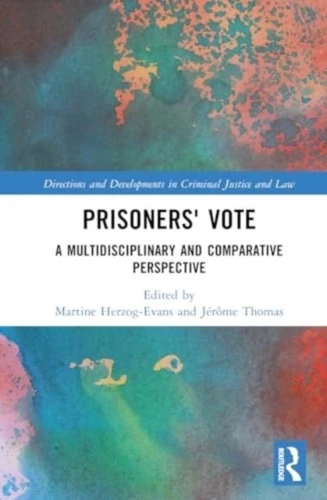
Through different legal and criminological angles and perspectives, this book addresses the controversial question of whether prisoners should have the right to vote, as well as the optimal modalities for such a vote. By adopting a comparative approach to explore the legal systems of very different jurisdictions, such as the former Eastern Bloc, England, Ireland, the USA, and France, the book reveals a recent trend in opening up the right to vote.
It also looks at the recommendations of international and European institutions which, while relatively cautious, nevertheless support such progress. Examining the issue from a criminological viewpoint, the book investigates the role that prisoners' votes could play in the social integration of these individuals into the community through political inclusion as citizens. Offering legal, theoretical and empirical bases, it blends a variety of perspectives to help readers establish an understanding of how prisoners' voting could contribute to improving their attachment to society and its values.
Concise and direct, Prisoners' Vote will be of great interest to upper-level students and scholars of law, criminology, sociology, criminal justice, and political science. It should also appeal to practitioners working in the criminal justice system and policy makers reflecting on whether and how, to open the right to vote to prisoners.
Through different legal and criminological angles and perspectives, this book addresses the controversial question of whether prisoners should have the right to vote, as well as the optimal modalities for such a vote. By adopting a comparative approach to explore the legal systems of very different jurisdictions, such as the former Eastern Bloc, England, Ireland, the USA, and France, the book reveals a recent trend in opening up the right to vote.
It also looks at the recommendations of international and European institutions which, while relatively cautious, nevertheless support such progress. Examining the issue from a criminological viewpoint, the book investigates the role that prisoners' votes could play in the social integration of these individuals into the community through political inclusion as citizens. Offering legal, theoretical and empirical bases, it blends a variety of perspectives to help readers establish an understanding of how prisoners' voting could contribute to improving their attachment to society and its values.
Concise and direct, Prisoners' Vote will be of great interest to upper-level students and scholars of law, criminology, sociology, criminal justice, and political science. It should also appeal to practitioners working in the criminal justice system and policy makers reflecting on whether and how, to open the right to vote to prisoners.