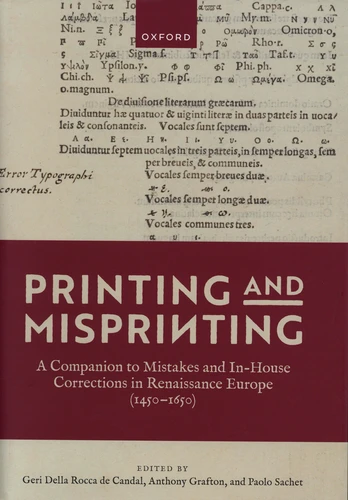
"To err is human". As a material and mechanical process, early printing made no exception to this general rule. Against the conventional wisdom of a technological triumph spreading freedom and knowledge, the history of the book is largely a story of errors and adjustments. Various mistakes normally crept in while texts were transferred from manuscript to printing formes, and different emendation strategies were adopted when errors were spotted.
In this regard, the "Gutenberg galaxy" provides an unrivalled example of how scholars, publishers, authors, and readers reacted to failure : they increasingly aimed at impeccability in both style and content, developed time- and money-efficient ways to cope with mistakes, and ultimately came to link formal accuracy with authoritative and reliable information. Most of these features shaped the publishing industry until the present day, in spite of mounting issues related to false news and approximation in the digital age.
Early modern misprinting, however, has so far received only passing mentions in scholarship and has never been treated together with proofreading in a complementary fashion. Correction benefited from a somewhat higher degree of attention, though the procedures in print shops have often been idealized as smooth and consistent. Furthermore, the emphasis has fallen on the people involved and their intervention in the linguistic and stylistic domains, rather than on their methodologies for dealing with typographical and textual mistakes.
This book seeks to fill this gap in the literature, providing the first comprehensive and interdisciplinary guide to the complex relationship between textual production in print, technical and human faults, and more or less successful attempts at emendation. The twenty-four carefully selected contributions present new evidence on what we can learn from misprints in relation to publishers' practices, printing and pre-publication procedures, and editorial strategies between 1450 and 1650.
They focus on texts, images, and the layout of incunabula, sixteenth- and early seventeenth-century books issued throughout Europe, stretching from the output of humanist printers to wide-ranging vernacular publications.
"To err is human". As a material and mechanical process, early printing made no exception to this general rule. Against the conventional wisdom of a technological triumph spreading freedom and knowledge, the history of the book is largely a story of errors and adjustments. Various mistakes normally crept in while texts were transferred from manuscript to printing formes, and different emendation strategies were adopted when errors were spotted.
In this regard, the "Gutenberg galaxy" provides an unrivalled example of how scholars, publishers, authors, and readers reacted to failure : they increasingly aimed at impeccability in both style and content, developed time- and money-efficient ways to cope with mistakes, and ultimately came to link formal accuracy with authoritative and reliable information. Most of these features shaped the publishing industry until the present day, in spite of mounting issues related to false news and approximation in the digital age.
Early modern misprinting, however, has so far received only passing mentions in scholarship and has never been treated together with proofreading in a complementary fashion. Correction benefited from a somewhat higher degree of attention, though the procedures in print shops have often been idealized as smooth and consistent. Furthermore, the emphasis has fallen on the people involved and their intervention in the linguistic and stylistic domains, rather than on their methodologies for dealing with typographical and textual mistakes.
This book seeks to fill this gap in the literature, providing the first comprehensive and interdisciplinary guide to the complex relationship between textual production in print, technical and human faults, and more or less successful attempts at emendation. The twenty-four carefully selected contributions present new evidence on what we can learn from misprints in relation to publishers' practices, printing and pre-publication procedures, and editorial strategies between 1450 and 1650.
They focus on texts, images, and the layout of incunabula, sixteenth- and early seventeenth-century books issued throughout Europe, stretching from the output of humanist printers to wide-ranging vernacular publications.