

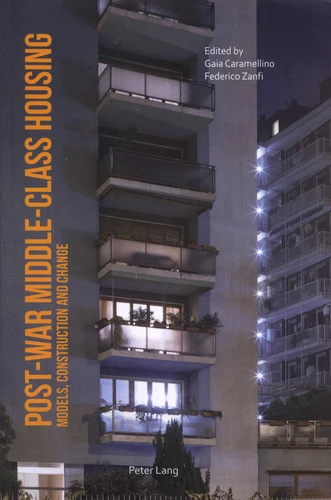
Post-War Middle-Class Housing. Models, Construction and Change
Par : ,Formats :
- Paiement en ligne :
- Livraison à domicile ou en point Mondial Relay estimée à partir du 2 décembreCet article sera commandé chez un fournisseur et vous sera envoyé 127 jours après la date de votre commande.
- Retrait Click and Collect en magasin gratuit
- Livraison à domicile ou en point Mondial Relay estimée à partir du 2 décembre
- Réservation en ligne avec paiement en magasin :
- Indisponible pour réserver et payer en magasin
- Nombre de pages446
- FormatGrand Format
- PrésentationBroché
- Poids0.62 kg
- Dimensions15,0 cm × 22,5 cm × 2,4 cm
- ISBN978-3-0343-1594-4
- EAN9783034315944
- Date de parution01/01/2016
- ÉditeurPeter Lang
Résumé
Post-war middle-class housing played a key role in constructing and transforming the cities of Europe and America, deeply impacting today's urban landscape. And yet, this stock has been underrepresented in a literature mostly focused on public housing and the work of a few master architects. This book is the first attempt to explore such housing from an international perspective. It provides a comparative insight into the processes of construction, occupation and transformation of residential architecture built for the middle-classes in 12 different countries between the 1950s and 1970s.
It investigates the role of models, actors and policies that shaped the middle-class city, tracing geographies, chronologies and forms of development that often cross national frontiers. This study is particularly relevant today within the context of "fragilization" which affects the middle-classes, challenging, as it does, the urban role played by this residential heritage in the light of technological obsolescence, trends in patterns of homeownership, as well as social and generational changes.
It investigates the role of models, actors and policies that shaped the middle-class city, tracing geographies, chronologies and forms of development that often cross national frontiers. This study is particularly relevant today within the context of "fragilization" which affects the middle-classes, challenging, as it does, the urban role played by this residential heritage in the light of technological obsolescence, trends in patterns of homeownership, as well as social and generational changes.