
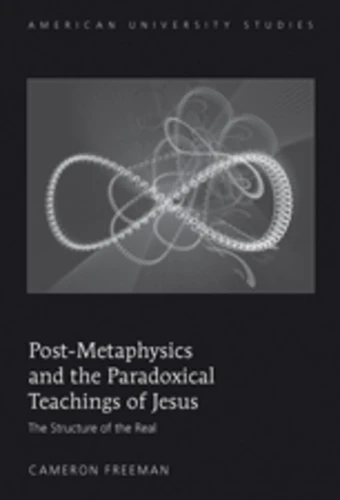
Post-Metaphysics and the Paradoxical Teachings of Jesus. The Structure of the Real
Par :Formats :
Expédié sous 127 jours
Cet article sera commandé chez un fournisseur et vous sera envoyé 127 jours après la date de votre commande.
- Paiement en ligne :
- Livraison à domicile ou en point Mondial Relay estimée à partir du 2 novembreCet article sera commandé chez un fournisseur et vous sera envoyé 127 jours après la date de votre commande.
- Retrait Click and Collect en magasin gratuit
- Livraison à domicile ou en point Mondial Relay estimée à partir du 2 novembre
- Réservation en ligne avec paiement en magasin :
- Indisponible pour réserver et payer en magasin
- Nombre de pages327
- ISBN978-1-4331-0861-7
- EAN9781433108617
- Date de parution01/12/2009
- CollectionAmerican University Studies
- ÉditeurPeter Lang
Résumé
Post-Metaphysics and the Paradoxical Teachings of Jesus : The Structure of the Real uncovers the authentic voice-print of Jesus' teachings on the Kingdom of God and thereby outlines a new approach to theological language after the ‘end of metaphysics'. By showing that the paradoxical ‘deep structure' of Jesus' most radical teachings survives the Death of God and the deconstruction of metaphysics in twentieth-century continental philosophy, this book aims to reconstruct the original teachings of Jesus in a way that can begin a new conversation on what it means to be a Christian in a post-Christian world, while drawing on a remarkable range of supporting material, including John D.
Caputo's award-winning theological appropriation of Derrida's deconstruction, the pioneering work of John Dominic Crossan on the parables of Jesus, and the novel insights of Jesus Seminar scholars Robert Funk and Branden Scott. Beginning with questions surrounding the ‘end of metaphysics' in Martin Heidegger's existentialist philosophy and moving on to the ethico-political dimensions of Derrida's work, this volume examines Nicholas of Cusa's notion of God as the coincidence of opposites, Buddhist genius Nagarjuna's dialectic of Emptiness, and the Hindu concept of non-duality in raising the possibility of a post-metaphysical theology.
Following an original unpacking of the parables of Jesus, the central thesis is woven together with reference to Moltmann's important work on the crucified God, as well as Kierkegaard and the Absolute Paradox, negative/mystical theology in the Christian tradition, twentieth-century Japanese philosopher Nishida Kitaro, and aspects of Nietzsche, Thomas Aquinas, Plato, Aristotle, Meister Eckhart, G. K.
Chesterton, Slavoj Zizek, and Ken Wilber.
Caputo's award-winning theological appropriation of Derrida's deconstruction, the pioneering work of John Dominic Crossan on the parables of Jesus, and the novel insights of Jesus Seminar scholars Robert Funk and Branden Scott. Beginning with questions surrounding the ‘end of metaphysics' in Martin Heidegger's existentialist philosophy and moving on to the ethico-political dimensions of Derrida's work, this volume examines Nicholas of Cusa's notion of God as the coincidence of opposites, Buddhist genius Nagarjuna's dialectic of Emptiness, and the Hindu concept of non-duality in raising the possibility of a post-metaphysical theology.
Following an original unpacking of the parables of Jesus, the central thesis is woven together with reference to Moltmann's important work on the crucified God, as well as Kierkegaard and the Absolute Paradox, negative/mystical theology in the Christian tradition, twentieth-century Japanese philosopher Nishida Kitaro, and aspects of Nietzsche, Thomas Aquinas, Plato, Aristotle, Meister Eckhart, G. K.
Chesterton, Slavoj Zizek, and Ken Wilber.