

Né à Tokyo en 1970, Tanaka est le président de Morning Garden Inc. et est diplômé de l'University of the Arts London et du London College of Communication. Tanaka écrit, édite et produit des livres axés sur le visuel. Il a notamment publié The Visual Dictionary of Philosophy, The Visual Dictionary of Philosophy (Part 2), The Visual Dictionary of Sociology (President Inc. ) et The Visual Dictionary of Psychology (Seibundo Shinkosha Publishing Co. , Ltd. ). Lauréat du Good Design Award 2011).
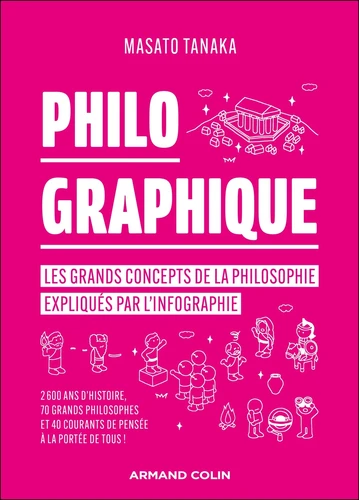
Philo graphique. Les grands concepts de la philosophie expliqués par l'infographie
Par :Formats :
- Paiement en ligne :
- Livraison à domicile ou en point Mondial Relay estimée à partir du 2 septembreCet article sera commandé chez un fournisseur et vous sera envoyé 11 jours après la date de votre commande.
- Retrait Click and Collect en magasin gratuit
- Réservation en ligne avec paiement en magasin :
- Indisponible pour réserver et payer en magasin
- Nombre de pages347
- FormatGrand Format
- PrésentationRelié
- Poids0.748 kg
- Dimensions17,9 cm × 24,9 cm × 2,5 cm
- ISBN978-2-200-64206-8
- EAN9782200642068
- Date de parution22/10/2025
- ÉditeurArmand Colin
- TraducteurAmeline Garnier
Résumé
LES PENSEES DE L'HOMME N'ONT JAMAIS ETE AUSSI LIMPIDES ! PHILO GRAPHIQUE MET A LA PORTEE DE TOUS 2 600 ANS DE PHILOSOPHIE, 200 CONCEPTS-CLES ET 70 FIGURES MAJEURES DE LA PENSEE OCCIDENTALE. DIDACTIQUE ET ACIDULEE, CETTE SYNTHESE RETRACE L'EVOLUTION DES IDEES DE L'ANTIQUITE A NOS JOURS ET EXPLIQUE LES CONCEPTS LES PLUS ARDUS A TRAVERS DES ILLUSTRATIONS ET DES INFOGRAPHIES ECLAIRANTES. UN OUTIL INDISPENSABLE POUR GARDER LE CAP DES IDEES DE PLATON AU DECONSTRUCTIVISME DE DERRIDA ET DOMPTER CES " MONSTRES DE LA PENSEE " D'HIER ET D'AUJOURD'HUI...
Thalès - Pythagore - Héraclite - Parménide - Protagoras - Gorgias - Socrate - Démocrite - Platon - Aristote - Zénon - Epicure - Augustin - Anselme d'Aoste - Thomas d'Aquin - Guillaume d'Ockham - Bacon - Locke - Berkeley - Hume - Descartes - Spinoza - Leibniz - Hobbes - Montesquieu - Rousseau - Montaigne - Pascal - Smith - Kant - Fichte - Schelling - Hegel - Schopenhauer - Kierkegaard - Marx - Nietzsche - Bentham - Mill - Peirce - James - Dewey - Freud - Jung - Russell - Wittgenstein - Carnap - Popper - Kuhn - Husserl - Heidegger - Jaspers - Sartre - Merleau-Ponty - Horkheimer - Habermas - Arendt - Lévinas - Saussure - Lévi-Strauss - Deleuze - Foucault - Derrida - Lyotard - Baudrillard - Rawls - Nozick - Sandel - Beauvoir - Butler - Saïd - Negri
Thalès - Pythagore - Héraclite - Parménide - Protagoras - Gorgias - Socrate - Démocrite - Platon - Aristote - Zénon - Epicure - Augustin - Anselme d'Aoste - Thomas d'Aquin - Guillaume d'Ockham - Bacon - Locke - Berkeley - Hume - Descartes - Spinoza - Leibniz - Hobbes - Montesquieu - Rousseau - Montaigne - Pascal - Smith - Kant - Fichte - Schelling - Hegel - Schopenhauer - Kierkegaard - Marx - Nietzsche - Bentham - Mill - Peirce - James - Dewey - Freud - Jung - Russell - Wittgenstein - Carnap - Popper - Kuhn - Husserl - Heidegger - Jaspers - Sartre - Merleau-Ponty - Horkheimer - Habermas - Arendt - Lévinas - Saussure - Lévi-Strauss - Deleuze - Foucault - Derrida - Lyotard - Baudrillard - Rawls - Nozick - Sandel - Beauvoir - Butler - Saïd - Negri