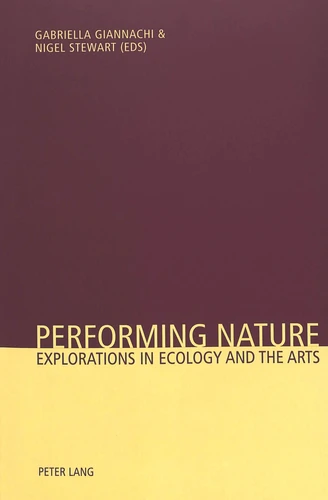
The essays in this volume explore the borderland between ecology and the arts. Nature is here read by a number of contributors as ‘cultural', by others as an ‘independent domain', or even as a powerful process of exchange 'between the human and the other-than-human'. The four parts of the volume reflect these different understandings of nature and performance. Informed by psychoanalysis and cultural materialism, contributors to the first part, ‘Spectacle : Landscape and Subjectivity', look at ways in which particular social and scientific experiments, theatre and film productions and photography either reinforce or contest our ideas about nature and human-human or human-animal relations and identities.
The second part, ‘World : Hermeneutic Language and Social Ecology', investigates political protest, social practice art, acoustic ecology, dance theatre, family therapy and ritual in terms of social philosophy. Contributors to the third part, ‘Environment : Immersiveness and Interactivity', explore architecture and sculpture, site-specific and mediatised dance and paratheatre through radical theories of urban and virtual space and time, or else phenomenological philosophy.
The final part, ‘Void : Death, Life and the Sublime', indicates the possibilities in dance, architecture and animal behaviour of a shift to an existential ontology in which nature has ‘the capacity to perform itself'.
The essays in this volume explore the borderland between ecology and the arts. Nature is here read by a number of contributors as ‘cultural', by others as an ‘independent domain', or even as a powerful process of exchange 'between the human and the other-than-human'. The four parts of the volume reflect these different understandings of nature and performance. Informed by psychoanalysis and cultural materialism, contributors to the first part, ‘Spectacle : Landscape and Subjectivity', look at ways in which particular social and scientific experiments, theatre and film productions and photography either reinforce or contest our ideas about nature and human-human or human-animal relations and identities.
The second part, ‘World : Hermeneutic Language and Social Ecology', investigates political protest, social practice art, acoustic ecology, dance theatre, family therapy and ritual in terms of social philosophy. Contributors to the third part, ‘Environment : Immersiveness and Interactivity', explore architecture and sculpture, site-specific and mediatised dance and paratheatre through radical theories of urban and virtual space and time, or else phenomenological philosophy.
The final part, ‘Void : Death, Life and the Sublime', indicates the possibilities in dance, architecture and animal behaviour of a shift to an existential ontology in which nature has ‘the capacity to perform itself'.