The Author : Thomas Cole was born in Chilhowie, Virginia (USA) in 1933. His undergraduate and graduate studies were conducted at Harvard University (1950-1954 and, following a Fulbright year in Italy and military service, 1957-1960). He has held visiting professorships at Harvard (Spring, 2003) and Urbino (Spring, 1988) as well as, from 1966 to 2000, a professorship of Greek and Latin at Yale, where he is now a professor emeritus.
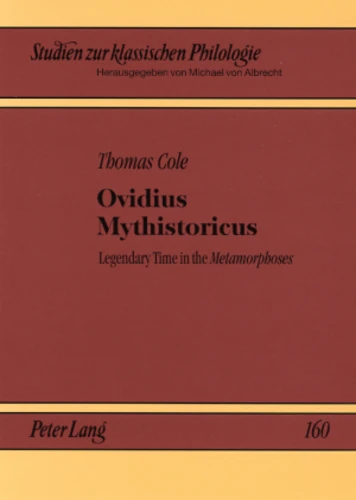
Ovidius Mythistoricus
Par :Formats :
- Paiement en ligne :
- Livraison à domicile ou en point Mondial Relay estimée à partir du 2 octobreCet article sera commandé chez un fournisseur et vous sera envoyé 25 jours après la date de votre commande.
- Retrait Click and Collect en magasin gratuit
- Nombre de pages222
- FormatGrand Format
- ISBN978-3-631-56959-7
- EAN9783631569597
- Date de parution01/01/2008
- ÉditeurPeter Lang
Résumé
The Metamorphoses is rarely read as history, but its immediate models were both historiographical : the Chronica of Castor of Rhodes and the De Gente Populi Romani of Marcus Terentius Varro. They determined the poem's chronological ordering of episodes and anticipated the way it views dynastic history in the "mythical" era of Greece and Italy as both a prelude to, and a source of precedents for, Roman imperium and Roman ruler cult.
Ovid's myth-historical poem is true to the "facts" of fabularis historia transmitted in Varro and Castor in the same way realistic historical novels are true to those of vera historia, but it combines fact with fictional supplements to create its own interpretation of the period dealt with. The result is a collective Bildungsroman taking mankind from its beginnings under divine patria potestas (books 1-5) past the erotic and military adventurism of 6-13 into a period of maturity (14-15) during which a series of leaders culminating in Augustus join or supplant the gods as guarantors of the universal rule of reason and law.
Ovid's myth-historical poem is true to the "facts" of fabularis historia transmitted in Varro and Castor in the same way realistic historical novels are true to those of vera historia, but it combines fact with fictional supplements to create its own interpretation of the period dealt with. The result is a collective Bildungsroman taking mankind from its beginnings under divine patria potestas (books 1-5) past the erotic and military adventurism of 6-13 into a period of maturity (14-15) during which a series of leaders culminating in Augustus join or supplant the gods as guarantors of the universal rule of reason and law.