
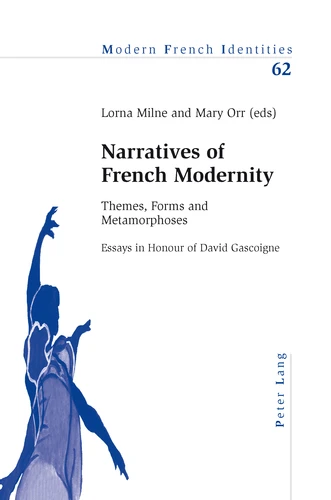
Narratives of French Modernity. Themes, Forms and Metamorphoses- Essays in Honour of David Gascoigne
Par : ,Formats :
- Paiement en ligne :
- Livraison à domicile ou en point Mondial Relay estimée à partir du 2 décembreCet article sera commandé chez un fournisseur et vous sera envoyé 127 jours après la date de votre commande.
- Retrait Click and Collect en magasin gratuit
- Livraison à domicile ou en point Mondial Relay estimée à partir du 2 décembre
- Réservation en ligne avec paiement en magasin :
- Indisponible pour réserver et payer en magasin
- Nombre de pages353
- ISBN978-3-03911-051-3
- EAN9783039110513
- Date de parution01/03/2011
- CollectionModern French Identities
- ÉditeurPeter Lang
Résumé
Inspired by the work of their colleague David Gascoigne, a group of scholars from the UK and France examine in this book the narrative strategies of some of the most interesting and important French writers of the twentieth and twenty-first centuries. Stretching chronologically from 1905 to 2005, the volume examines a wide variety of prose genres, from pornography to Bildungsroman to magic realism, as well as poetry.
Michel Tournier figures in several of the contributions, emerging as something of a touchstone for many of the thematic preoccupations that are common throughout the period : values and authority, self and other, identity, spirituality, migration and exile, sexuality, the body, violence and war, and language. The authors also examine the flourishing of intertextuality, as well as the use of traditional forms, such as mythical structures and the ‘robinsonade', to undermine authoritative ‘métarécits'.
Probing these themes and forms, and their metamorphoses across 100 years, the essays demonstrate a striking degree of continuity, linking writers as different as Apollinaire and Houellebecq or Valéry and Fleutiaux, and highlight the difficulty of dividing the period neatly into chronologically ordered categories labelled ‘modern' or ‘postmodern'.
Michel Tournier figures in several of the contributions, emerging as something of a touchstone for many of the thematic preoccupations that are common throughout the period : values and authority, self and other, identity, spirituality, migration and exile, sexuality, the body, violence and war, and language. The authors also examine the flourishing of intertextuality, as well as the use of traditional forms, such as mythical structures and the ‘robinsonade', to undermine authoritative ‘métarécits'.
Probing these themes and forms, and their metamorphoses across 100 years, the essays demonstrate a striking degree of continuity, linking writers as different as Apollinaire and Houellebecq or Valéry and Fleutiaux, and highlight the difficulty of dividing the period neatly into chronologically ordered categories labelled ‘modern' or ‘postmodern'.