

Eduardo Souza de Cursi is Professor, Director of European and International Relations and Director of the Laboratory of Mechanics at INSA-Rouen in France. Rubens Sampaio is Professor at PUC-Rio, Rio de Janeiro, Brazil. His fields of interest are Applied Mathematics and Mechanics.
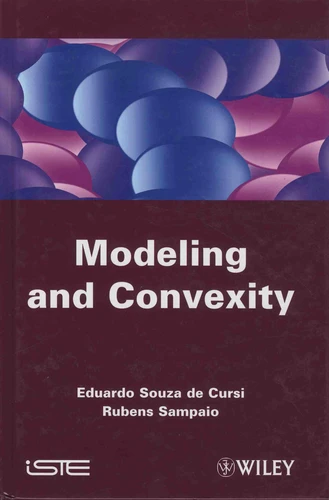
Modeling and Convexity
Par : ,Formats :
- Paiement en ligne :
- Livraison à domicile ou en point Mondial Relay estimée à partir du 8 octobreCet article sera commandé chez un fournisseur et vous sera envoyé 25 jours après la date de votre commande.
- Retrait Click and Collect en magasin gratuit
- Nombre de pages503
- FormatGrand Format
- PrésentationRelié
- Poids0.907 kg
- Dimensions15,7 cm × 23,4 cm × 3,3 cm
- ISBN978-1-84821-177-3
- EAN9781848211773
- Date de parution01/07/2010
- ÉditeurCoédition ISTE/Wiley
Résumé
Convexity is a central concept in Applied Sciences and Engineering. It is central to the mathematical formalization of many physical phenomena and a large number of numerical procedures depend upon it. For example, convex analysis tools are involved in the modeling of mechanical systems containing unilateral constraints (contact, friction, plasticity, etc.), in the definition of constitutive relations of materials, and in variational and optimization methods.
This reference work gives the reader a complete and comprehensive presentation of the foundations of convex analysis and includes applications of practical significance and importance in engineering. The presentation of the theory is self-contained and proof of all the essential results is given. The examples consider meaningful situations such as the modeling of curvilinear structures, the motion of a mass of people or the solidification of a material.
Non-convex situations are considered by means of relaxation methods and the connections between probability and convexity are explored and exploited in order to generate numerical algorithms.
This reference work gives the reader a complete and comprehensive presentation of the foundations of convex analysis and includes applications of practical significance and importance in engineering. The presentation of the theory is self-contained and proof of all the essential results is given. The examples consider meaningful situations such as the modeling of curvilinear structures, the motion of a mass of people or the solidification of a material.
Non-convex situations are considered by means of relaxation methods and the connections between probability and convexity are explored and exploited in order to generate numerical algorithms.
A propos de Eduardo Souza de Cursi
120,00 €
Variational Methods for Engineers with Matlab
Grand Format
48,40 €