
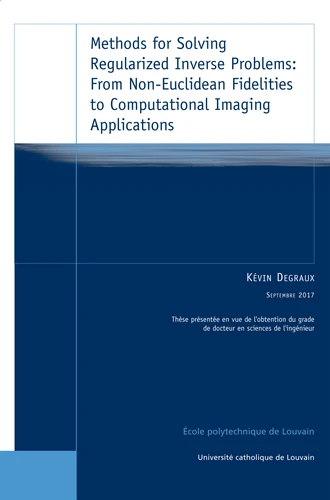
Methods for Solving Regularized Inverse Problems: From Non-Euclidean Fidelities to Computational Imaging Applications
Par :Formats :
- Paiement en ligne :
- Livraison à domicile ou en point Mondial Relay estimée à partir du 5 janvierCet article sera commandé chez un fournisseur et vous sera envoyé 127 jours après la date de votre commande.
- Retrait Click and Collect en magasin gratuit
- Réservation en ligne avec paiement en magasin :
- Indisponible pour réserver et payer en magasin
- Nombre de pages226
- PrésentationBroché
- Poids0.367 kg
- Dimensions16,0 cm × 24,0 cm × 0,0 cm
- ISBN978-2-87558-605-6
- EAN9782875586056
- Date de parution19/10/2017
- ÉditeurPresses universitaires Louvain
Résumé
Many branches of science and engineering are concerned with the problem of recording signals from physical phenomena. However, an acquisition system does not always directly provide the high-quality signal representations that a given application requires. Signal processing and the study of inverse problems offer a set of powerful tools to recover a good signal quality from altered raw measurements.
After an overview of the field, this thesis presents three contributions. The first contribution focuses on recovering a key structural property of a sparse signal, its support. It discusses guarantees associated to a convex optimization method with atypical fidelity, e. g. , using a non-Euclidean norm. The second part introduces a method for learning a convolutional dictionary, used as a multimodal imaging prior.
This constitutes a practical way of sharing information between several imaging modalities, such as depth and light intensity. The last contribution revolves around the design of two multispectral compressive imaging strategies using spectrally filtered sensors. The first scheme relies on a generalized inpainting formulation in the multispectral volume, while the second system leverages the principles of compressed sensing from coded optical convolutions.
This last chapter studies and compares both sensing models and discusses implementation challenges and tradeoffs.
After an overview of the field, this thesis presents three contributions. The first contribution focuses on recovering a key structural property of a sparse signal, its support. It discusses guarantees associated to a convex optimization method with atypical fidelity, e. g. , using a non-Euclidean norm. The second part introduces a method for learning a convolutional dictionary, used as a multimodal imaging prior.
This constitutes a practical way of sharing information between several imaging modalities, such as depth and light intensity. The last contribution revolves around the design of two multispectral compressive imaging strategies using spectrally filtered sensors. The first scheme relies on a generalized inpainting formulation in the multispectral volume, while the second system leverages the principles of compressed sensing from coded optical convolutions.
This last chapter studies and compares both sensing models and discusses implementation challenges and tradeoffs.
L'éditeur en parle
Many branches of science and engineering are concerned with the problem of recording signals from physical phenomena. However, an acquisition system does not always directly provide the high-quality signal representations that a given application requires...