
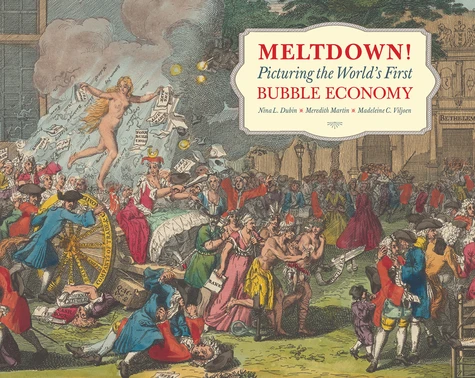
Meltdown! Picturing the World’s First Bubble Economy
Par : , ,Formats :
- Nombre de pages157
- PrésentationRelié
- Poids1.33 kg
- Dimensions30,0 cm × 24,0 cm × 0,0 cm
- ISBN978-1-912554-51-5
- EAN9781912554515
- Date de parution22/12/2020
- CollectionHarvey Miller - Art History (O
- ÉditeurHarvey Miller Publishers
Résumé
This book tells two parallel stories : one of the spectacular rise and fall of the world's first bubble economy, and another of the enterprising art industry that chronicled its collapse. The Mississippi and South Sea Bubbles, spawning the invention of French banknotes as well as joint-stock companies built on fantasies of New World trade, imposed on everyday Europeans a crash course in new financial products.
In turn, a bubbling print market relentlessly caricatured the meltdown of 1720, offering viewers an entertaining primer on the otherwise bewildering realities of modern economic life. Such satirical works — most notably a Dutch compendium titled The Great Mirror of Folly (Het groote tafereel der dwaasheid) — helped to demystify the disaster by deploying familiar theatrical characters and tragic-comic motifs.
Likening the speculative mania to an infectious disease, and spoofing the "herd behavior" of a money-crazed public, its prints portrayed malevolent traders, hoodwinked investors, and a chorus of heroes and villains both real and legendary, from the rakish financier John Law to the foolish Harlequin to the goddess Fortuna. Three hundred years later, our current moment offers a uniquely fitting vantage point from which to reconsider the significance of the bubbles and of the artworks that channeled the fears and desires they unleashed.
In turn, a bubbling print market relentlessly caricatured the meltdown of 1720, offering viewers an entertaining primer on the otherwise bewildering realities of modern economic life. Such satirical works — most notably a Dutch compendium titled The Great Mirror of Folly (Het groote tafereel der dwaasheid) — helped to demystify the disaster by deploying familiar theatrical characters and tragic-comic motifs.
Likening the speculative mania to an infectious disease, and spoofing the "herd behavior" of a money-crazed public, its prints portrayed malevolent traders, hoodwinked investors, and a chorus of heroes and villains both real and legendary, from the rakish financier John Law to the foolish Harlequin to the goddess Fortuna. Three hundred years later, our current moment offers a uniquely fitting vantage point from which to reconsider the significance of the bubbles and of the artworks that channeled the fears and desires they unleashed.