Cassidy R Sugimoto is Associate Professor of Informatics at Indiana University Bloomington. Vincent Larivière is Associate Professor of Information Science and Canada Research Chair in the Transformations of Scholarly Communication at the Université de Montréal.
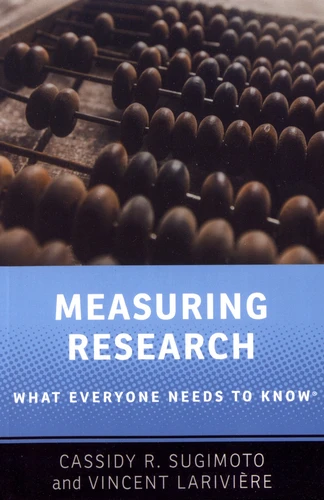
Measuring Research. What Everyone Needs to Know
Par : ,Formats :
- Paiement en ligne :
- Livraison à domicile ou en point Mondial Relay estimée à partir du 7 octobreCet article sera commandé chez un fournisseur et vous sera envoyé 25 jours après la date de votre commande.
- Retrait Click and Collect en magasin gratuit
- Nombre de pages150
- FormatGrand Format
- PrésentationBroché
- Poids0.2 kg
- Dimensions14,0 cm × 21,0 cm × 1,0 cm
- ISBN978-0-19-064012-5
- EAN9780190640125
- Date de parution02/01/2018
- ÉditeurOxford University Press
Résumé
Policy makers, academic administrators, scholars, and members of the public are clamoring for indicators of the value and reach of research. The question of how to quantify the impact and importance of research and scholarly output, from the publication of books and journal articles to the indexing of citations and tweets, is a critical one for understanding science and conducting assessments of research.
There is a wide set of data and tools available for measuring research, but they are often used in crude ways, and each have their own limitations and internal logics. Measuring Research : What Everyone Needs to Know will provide, for the first time, an accessible account of the methods used to gather and analyze data on research output and impact. Following a brief history of scholarly communication and its measurement —- from traditional peer review to crowdsourced review on the social web - —the book will look at the classification of knowledge and academic disciplines, the difference between and characteristics of citations and references, the role of peer review, national research evaluation exercises, the tools used to measure research, the many different types of measurement indicators, and how to measure interdisciplinarity.
The book also addresses emerging issues within scholarly communication, including whether or not measurement promotes a "publish or perish" culture, fraud in research, or "citation cartels". It will also look at the stakeholders behind these analytical tools, the adverse effects of these quantifications, and the future of research measurement.
There is a wide set of data and tools available for measuring research, but they are often used in crude ways, and each have their own limitations and internal logics. Measuring Research : What Everyone Needs to Know will provide, for the first time, an accessible account of the methods used to gather and analyze data on research output and impact. Following a brief history of scholarly communication and its measurement —- from traditional peer review to crowdsourced review on the social web - —the book will look at the classification of knowledge and academic disciplines, the difference between and characteristics of citations and references, the role of peer review, national research evaluation exercises, the tools used to measure research, the many different types of measurement indicators, and how to measure interdisciplinarity.
The book also addresses emerging issues within scholarly communication, including whether or not measurement promotes a "publish or perish" culture, fraud in research, or "citation cartels". It will also look at the stakeholders behind these analytical tools, the adverse effects of these quantifications, and the future of research measurement.