
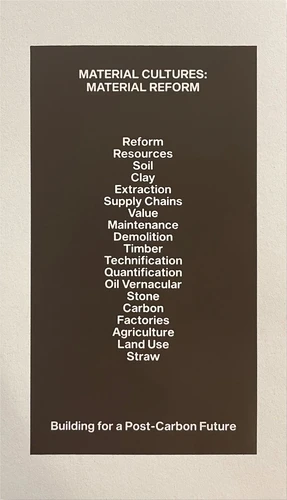
Material Cultures: Material Reform. Building for a Post-Carbon Future
Par :Formats :
- Nombre de pages143
- FormatPoche
- PrésentationBroché
- Poids0.11 kg
- Dimensions11,0 cm × 18,0 cm × 1,0 cm
- ISBN978-1-913620-81-3
- EAN9781913620813
- Date de parution05/11/2022
- ÉditeurMack
- PréfacierCharlotte Malterre-Barthes
- PhotographeJess Gough
Résumé
"'Our current modus operandi can't support the kinds of futures we envision for ourselves and those to come. As architects, builders, and citizens, we must urgently rethink our relationship to the land and to each other to produce new forms of material practice, culture, and economy in solidarity with people and our landscapes. ' This book, the first by the design and research practice Material Cultures, assembles a series of short essays and conversations exploring the cultures, systems, and infrastructures that shape the architectural industry and the destructive ecologies it fosters.
The building practices dominating contemporary architecture are rooted in the exploitation of people and the degradation of our landscapes. Here, Paloma Gormley, Summer Islam, and George Massoud explore how this has come about and how alternative systems, with holistic approaches to the built environment, might be formulated. Material Reform presents a set of instructive and challenging perspectives drawing directly on the dialogues and tensions Material Cultures encounter in their ongoing work.
Texts centred around key concepts including labour, time, maintenance, language, land, and touch are interwoven with a visual essay reckoning with the processes that have transformed industrialized landscapes at different scales of experience and resolution. Through text and visuals, concepts and practice, this book explores how developing a direct relationship with materials can help us find new languages with the potential to supersede those we have inherited from a narrow lineage of authors.
These discursive threads come together to form a vital sourcebook for rethinking our relationships to materials, land, and development, in all their crucial intersections".
The building practices dominating contemporary architecture are rooted in the exploitation of people and the degradation of our landscapes. Here, Paloma Gormley, Summer Islam, and George Massoud explore how this has come about and how alternative systems, with holistic approaches to the built environment, might be formulated. Material Reform presents a set of instructive and challenging perspectives drawing directly on the dialogues and tensions Material Cultures encounter in their ongoing work.
Texts centred around key concepts including labour, time, maintenance, language, land, and touch are interwoven with a visual essay reckoning with the processes that have transformed industrialized landscapes at different scales of experience and resolution. Through text and visuals, concepts and practice, this book explores how developing a direct relationship with materials can help us find new languages with the potential to supersede those we have inherited from a narrow lineage of authors.
These discursive threads come together to form a vital sourcebook for rethinking our relationships to materials, land, and development, in all their crucial intersections".