Lentin Joseph is an author, entrepreneur, electronics engineer, robotics enthusiast machine vision expert embedded programmer, and the founder and CEO of Qbotics Labs from India. He completed his bachelor's degree in electronics and communication engineering at the Federal Institute of Science and Technology (FISAT), Kerala. For his final year engineering project he made a social robot that can interact with people.
The project was a huge success and was mentioned in many forms of visual and print media. The main features of this robot were that it can communicate with people and reply intelligently and has some image processing capabilities such as face, motion, and color detection. The entire project was implemented using the Python programming language. His interest in robotics, image processing, and Python started with that project.
After his graduation, for 3 years he worked in a start-up company focusing on robotics d image processing. In the meantime, he teamed famous robotic software platforms sorb as Robot Operating System (ROS), V-REP, Actin (a robotic simulation tool), and image processing libraries such as OpenCV, OpenNL and POL He also knows robot 3D designing and embedded programming on Arduino and Tiva Launchpad. After 3 years of work experience, he started a new company called Qbotics Labs, which mainly focuses on research to build up some great products in domains such as robotics and machine vision.
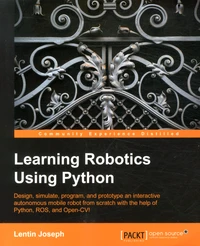
He maintains a personal website and a technology blog called technolabsz. He publishes his works on his tech blog. He was also a speaker at PyCon2013, India, on the topic Learning Robotics using Python. Lentin is the author of the book Learning Robotics Using Python by Packt Publishing. The book was about building an autonomous mobile robot using ROS and OpenCV. The book was launched in ICRA 2015 and was featured in the ROS blog, Robohub, OpenCV, the Python website, and various other such forums.
Lentin was a finalist in the ICRA 2015 challenge, HRATC. I dedicate this book to my parents because they gave me the inspiration to write this book. I also convey my regards to my friends who helped and inspired me to write this book.
The project was a huge success and was mentioned in many forms of visual and print media. The main features of this robot were that it can communicate with people and reply intelligently and has some image processing capabilities such as face, motion, and color detection. The entire project was implemented using the Python programming language. His interest in robotics, image processing, and Python started with that project.
After his graduation, for 3 years he worked in a start-up company focusing on robotics d image processing. In the meantime, he teamed famous robotic software platforms sorb as Robot Operating System (ROS), V-REP, Actin (a robotic simulation tool), and image processing libraries such as OpenCV, OpenNL and POL He also knows robot 3D designing and embedded programming on Arduino and Tiva Launchpad. After 3 years of work experience, he started a new company called Qbotics Labs, which mainly focuses on research to build up some great products in domains such as robotics and machine vision.
He maintains a personal website and a technology blog called technolabsz. He publishes his works on his tech blog. He was also a speaker at PyCon2013, India, on the topic Learning Robotics using Python. Lentin is the author of the book Learning Robotics Using Python by Packt Publishing. The book was about building an autonomous mobile robot using ROS and OpenCV. The book was launched in ICRA 2015 and was featured in the ROS blog, Robohub, OpenCV, the Python website, and various other such forums.
Lentin was a finalist in the ICRA 2015 challenge, HRATC. I dedicate this book to my parents because they gave me the inspiration to write this book. I also convey my regards to my friends who helped and inspired me to write this book.