

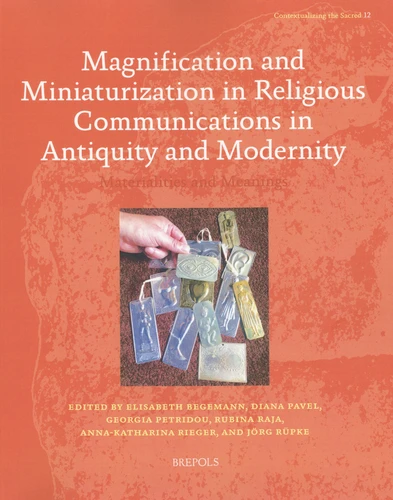
Magnification and Miniaturization in Religious Communications in Antiquity and Modernity. Materialities and Meanings
Par : , , ,Formats :
- Paiement en ligne :
- Livraison à domicile ou en point Mondial Relay estimée à partir du 29 septembreCet article sera commandé chez un fournisseur et vous sera envoyé 23 jours après la date de votre commande.
- Retrait Click and Collect en magasin gratuit
- Nombre de pages224
- FormatGrand Format
- PrésentationBroché
- Poids0.97 kg
- Dimensions22,0 cm × 28,0 cm × 2,0 cm
- ISBN978-2-503-60479-4
- EAN9782503604794
- Date de parution01/01/2023
- CollectionContextualizing the Sacred
- ÉditeurBrepols
Résumé
Human agents might not be the measure of all things. Nonetheless, human bodies, and their bodily dimensions, often are, with size impacting on the ways in which we conceive of, interact with, and relate to the world around us. The scaling up or down of features - magnification and miniaturization - is particularly evident in the creation of anthropogenic items intended for use in religious ritual, and here sizing can be employed as a deliberate strategy to encourage shock and awe, admiration and deterrence, among spectators.
Taking as its starting point the concept of "materialities and meanings", this volume explores how human perceptions and understanding of magnified and miniaturized forms and structures are shaped and changed, both synchronically and diachronically, by our understanding of the human body and its size, and the impact that this has in our relationship with the wider world in the context of ritual practices.
The chapters collected here consider a range of questions, from a discussion on the essentials of magnification or miniaturization to an exploration of the impact of such strategies on humans and their wider sociopolitical ramifications. Together, these chapters contribute to a unique discussion that offers new insights into "materialities and meanings", the creation of items for ritual, and the ways in which they influence human perception and understanding.
Contextualizing the Sacred : Sacred space and its material culture in the ancient Near East and Egypt, 1000 BC - AD 600. Sacred space, its use, development and meaning, is a major theme in archaeology and ancient history, and productive of research questions relating to religious identity, performance and practice, change, innovation, and dissolution. This series seeks to integrate the study of archaeology, texts, architecture, and religion, creating a forum for interdisciplinary and comparative studies of landscapes and domains of evidence that are normally treated separately.
The series is open to thematic, cross-regional and diachronic studies, as well as specific works within ancient history, classical archaeology, Egyptology, Assyriology, archaeology and philology that treat sacred space and its material culture in regions encompassed by the designation "Ancient Near East". Studies that seek to make issues and questions from one area accessible and thought-provoking to scholars in another are welcome.
Taking as its starting point the concept of "materialities and meanings", this volume explores how human perceptions and understanding of magnified and miniaturized forms and structures are shaped and changed, both synchronically and diachronically, by our understanding of the human body and its size, and the impact that this has in our relationship with the wider world in the context of ritual practices.
The chapters collected here consider a range of questions, from a discussion on the essentials of magnification or miniaturization to an exploration of the impact of such strategies on humans and their wider sociopolitical ramifications. Together, these chapters contribute to a unique discussion that offers new insights into "materialities and meanings", the creation of items for ritual, and the ways in which they influence human perception and understanding.
Contextualizing the Sacred : Sacred space and its material culture in the ancient Near East and Egypt, 1000 BC - AD 600. Sacred space, its use, development and meaning, is a major theme in archaeology and ancient history, and productive of research questions relating to religious identity, performance and practice, change, innovation, and dissolution. This series seeks to integrate the study of archaeology, texts, architecture, and religion, creating a forum for interdisciplinary and comparative studies of landscapes and domains of evidence that are normally treated separately.
The series is open to thematic, cross-regional and diachronic studies, as well as specific works within ancient history, classical archaeology, Egyptology, Assyriology, archaeology and philology that treat sacred space and its material culture in regions encompassed by the designation "Ancient Near East". Studies that seek to make issues and questions from one area accessible and thought-provoking to scholars in another are welcome.