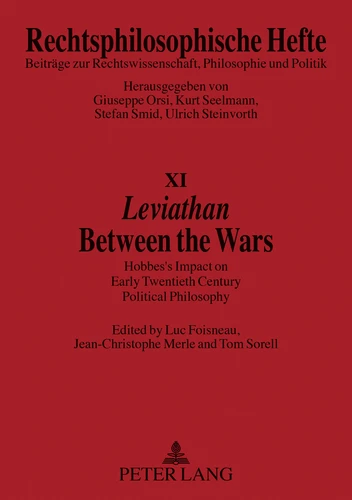
The Editors : Luc Foisneau is a Senior research fellow at the French national centre for scientific research (CNRS, Maison française, Oxford). Jean-Christophe Merle is Professor at the University of Tours (France). Tom Sorell is Professor at Essex University (UK).
«Leviathan-» Between the Wars. Hobbes’ Impact on Early Twentieth Century Political Philosophy
Par : , ,Formats :
- Paiement en ligne :
- Livraison à domicile ou en point Mondial Relay estimée à partir du 1 octobreCet article sera commandé chez un fournisseur et vous sera envoyé 25 jours après la date de votre commande.
- Retrait Click and Collect en magasin gratuit
- Nombre de pages168
- ISBN3-631-51239-2
- EAN9783631512395
- Date de parution01/06/2005
- CollectionRechtsphilosophische Hefte
- ÉditeurPeter Lang
Résumé
The symbol of the Leviathan came to the forefront in political theory, as the structure and the ideological justification of the state underwent radical change in at least three European countries from the early 1920s to the 1940s. Thus, the terrifying image of Leviathan has sometimes given rise to a surprising historiography of twentieth-century totalitarian states, tracing them back to the origins of modern political thought, as if there were a direct line of descent from Hobbes to Mussolini, Hitler and Stalin, or, worse still, as if Hobbes's Leviathan (1651) were an exact anticipation of twentieth-century political catastrophes.
The differing interpretations of Hobbes proposed by Strauss, Tönnies, Schmitt, Vialatoux, Capitant, Pareto, Collingwood, and Oakeshott, are here interpreted in the perspective of the interwar transformation of Europe. The contributors, who are German, British and French political philosophers, analyse the conditions which have made possible conflicting readings of Hobbes's political philosophy, and explain why they sometimes don't do justice to Leviathan.
The differing interpretations of Hobbes proposed by Strauss, Tönnies, Schmitt, Vialatoux, Capitant, Pareto, Collingwood, and Oakeshott, are here interpreted in the perspective of the interwar transformation of Europe. The contributors, who are German, British and French political philosophers, analyse the conditions which have made possible conflicting readings of Hobbes's political philosophy, and explain why they sometimes don't do justice to Leviathan.