

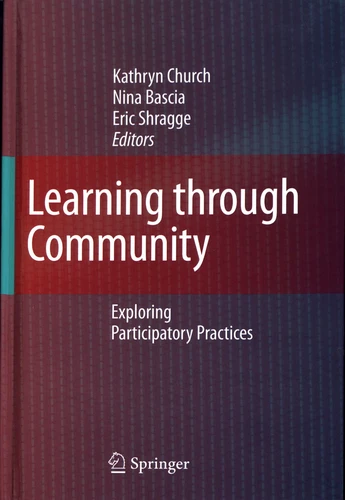
Learning through Community. Exploring Participatory Practices
Par : , ,Formats :
- Nombre de pages213
- FormatGrand Format
- PrésentationRelié
- Poids0.504 kg
- Dimensions16,0 cm × 23,5 cm × 1,3 cm
- ISBN978-1-4020-6653-5
- EAN9781402066535
- Date de parution01/02/2008
- ÉditeurSpringer
Résumé
This book is a collection of case studies that explore the learning that people do through community engagement. Developed within a network of Canadian researchers and their community partners, it explores learning that is organized by the learners themselves, collectively, rather than as individuals. Reflecting the contributors' political priorities, the volume begins with groups that are highly marginalized in our society : immigrant women, sex trade workers, senior citizens, garment workers, women doing community economic development, and people who identify with disability and anti-poverty movements.
It then shifts to consider groups whose members have been accustomed to seeing themselves as "centered" or mainstream : teachers, for example, and employees of the new "learning organizations". Regardless of their location, the people involved are learning to labour and to survive the turbulence of rapid socio-economic change in the global economy. These case studies trace the enduring effects of gender, class, language, race, and governmentality on their efforts.
Significantly, they also probe the possibilities for oppositional action.
It then shifts to consider groups whose members have been accustomed to seeing themselves as "centered" or mainstream : teachers, for example, and employees of the new "learning organizations". Regardless of their location, the people involved are learning to labour and to survive the turbulence of rapid socio-economic change in the global economy. These case studies trace the enduring effects of gender, class, language, race, and governmentality on their efforts.
Significantly, they also probe the possibilities for oppositional action.