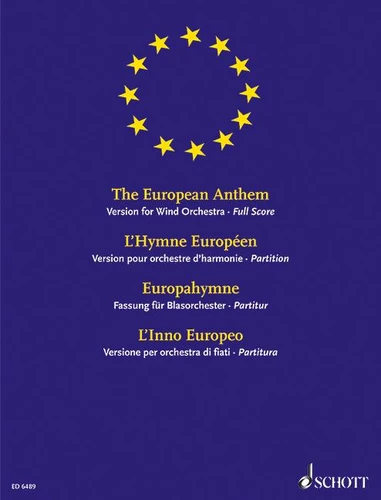
L'Hymne Européen. Musique du dernier mouvement de la Neuvième Symphonie. wind band. Partition.
Par :Formats :
- Paiement en ligne :
- Livraison à domicile ou en point Mondial Relay estimée à partir du 2 décembreCet article sera commandé chez un fournisseur et vous sera envoyé 127 jours après la date de votre commande.
- Retrait Click and Collect en magasin gratuit
- Livraison à domicile ou en point Mondial Relay estimée à partir du 2 décembre
- Réservation en ligne avec paiement en magasin :
- Indisponible pour réserver et payer en magasin
- Nombre de pages16
- Poids0.074 kg
- ISBNM-001-06893-8
- EAN9790001068932
- Date de parution01/01/2000
- CollectionCONCERT BAND/HA
- ÉditeurSchott
- MusicienHerbert von Karajan
Résumé
The European Hymn is the hymn not only of the European Union but of Europe in a broader sense. The melody has been taken from the Ninth Symphony by Ludwig van Beethoven from 1823. In the last movement of this symphony Beethoven set music to the 'Ode to Joy' by Friedrich von Schiller from 1785. This poem sprang from Schiller's idealistic vision of men who become brothers - a vision Beethoven shared with him.
In 1972 the Council of Europe adopted Beethoven's 'Ode to Joy' as its anthem. The well-known conductor Herbert von Karajan was commissioned to arrange three instrumental versions - for solo piano, wind orchestra and symphony orchestra. Without words, in the universal language of music, the anthem is an expression of the idealistic values of freedom, peace and solidarity which Europe stands for. In 1985 the heads of state and government adopted the hymn as the EU's official anthem.
It does not replace the national anthems of the member states, but rather celebrates common values as well as unity in diversity. The score of this offical anthem is exclusively available from the Schott publishing house. Instrumentation : wind band
In 1972 the Council of Europe adopted Beethoven's 'Ode to Joy' as its anthem. The well-known conductor Herbert von Karajan was commissioned to arrange three instrumental versions - for solo piano, wind orchestra and symphony orchestra. Without words, in the universal language of music, the anthem is an expression of the idealistic values of freedom, peace and solidarity which Europe stands for. In 1985 the heads of state and government adopted the hymn as the EU's official anthem.
It does not replace the national anthems of the member states, but rather celebrates common values as well as unity in diversity. The score of this offical anthem is exclusively available from the Schott publishing house. Instrumentation : wind band
L'éditeur en parle
Die Europahymne ist die Hymne nicht nur der Europäischen Union, sondern Europas in einem weiteren Sinne. Die Melodie ist der Neunten Symphonie Ludwig van Beethovens von 1823 entnommen. Mit dem letzten Satz dieser Symphonie vertonte Beethoven die "Ode an die Freude" von Friedrich von Schiller aus dem Jahr 1785. Dieses Gedicht entsprang Schillers idealistischer Vision der Menschen, die zu Brüdern werden - einer Vision, die Beethoven teilte.
1972 nahm der Europarat Beethovens "Ode an die Freude" als eigene Hymne an. Der bekannte Dirigent Herbert von Karajan wurde damit beauftragt, drei Instrumentalfassungen - für Solopiano, Blas- und Symphonieorchester - zu arrangieren. Ohne Worte, in der universalen Sprache der Musik, ist die Hymne Ausdruck der idealistischen Werte Freiheit, Frieden und Solidarität, für die Europa steht. 1985 wurde sie von den Staats- und Regierungschefs der Union als offizielle Hymne der EU angenommen.
Sie soll die Nationalhymnen der Mitgliedstaaten nicht ersetzen, sondern versinnbildlicht die Werte, die sie alle teilen sowie die Einheit in der Vielfalt. Die Noten zu dieser offiziellen Hymne sind exklusiv im Schott-Verlag erhältlich. Besetzung : wind band
1972 nahm der Europarat Beethovens "Ode an die Freude" als eigene Hymne an. Der bekannte Dirigent Herbert von Karajan wurde damit beauftragt, drei Instrumentalfassungen - für Solopiano, Blas- und Symphonieorchester - zu arrangieren. Ohne Worte, in der universalen Sprache der Musik, ist die Hymne Ausdruck der idealistischen Werte Freiheit, Frieden und Solidarität, für die Europa steht. 1985 wurde sie von den Staats- und Regierungschefs der Union als offizielle Hymne der EU angenommen.
Sie soll die Nationalhymnen der Mitgliedstaaten nicht ersetzen, sondern versinnbildlicht die Werte, die sie alle teilen sowie die Einheit in der Vielfalt. Die Noten zu dieser offiziellen Hymne sind exklusiv im Schott-Verlag erhältlich. Besetzung : wind band