
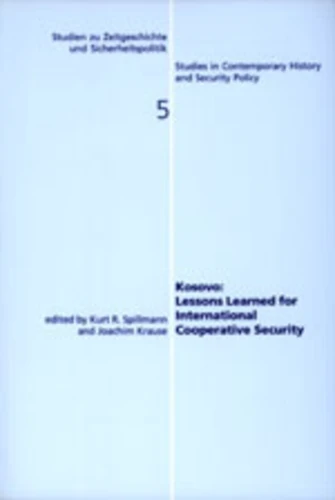
The Editors : Prof. Dr. Kurt R. Spillmann is founder and since 1986 director of the Center for Security Studies and Conflict Research at the Swiss Federal Institute of Technology in Zurich. Dr. Joachim Krause is Deputy Director of the Research Institute at the German Society for Foreign Affairs in Berlin and teaches political science at the University of Bonn.
Kosovo: Lessons Learned for International Cooperative Security
Par : ,Formats :
- Paiement en ligne :
- Livraison à domicile ou en point Mondial Relay estimée à partir du 29 septembreCet article sera commandé chez un fournisseur et vous sera envoyé 25 jours après la date de votre commande.
- Retrait Click and Collect en magasin gratuit
- Nombre de pages244
- ISBN3-906765-16-4
- EAN9783906765167
- Date de parution01/03/2000
- CollectionStudien zu Zeitgeschichte und
- ÉditeurPeter Lang
Résumé
The Kosovo crisis of 1999 was one of the most challenging events for cooperative security. Since the end of the Cold War, the European states, the United States and Canada have made progress in devising a new security architecture. However, the wars in the former Yugoslavia seemed to indicate that the new international order was not able to live up to its expectations. For the fourth time in eight years the Yugoslav president Slobodan Milosevic and those political forces he stands for tried to resolve an ethnic problem by means of ethnic cleansing.
Unlike in Bosnia-Herzegovina or in Croatia, the Western world reacted with much more determination and resolve. The outcome was an accord that was made in early June 1999 and which has to be seen against the backdrop of a major international crisis. This book critically examines the various efforts to resolve the Kosovo problem by ways of cooperative security. It also deals with the problems that started after the agreement of 9 June 1999.
Furthermore, it tries to shed light on the broader regional and international aspects of that crisis.
Unlike in Bosnia-Herzegovina or in Croatia, the Western world reacted with much more determination and resolve. The outcome was an accord that was made in early June 1999 and which has to be seen against the backdrop of a major international crisis. This book critically examines the various efforts to resolve the Kosovo problem by ways of cooperative security. It also deals with the problems that started after the agreement of 9 June 1999.
Furthermore, it tries to shed light on the broader regional and international aspects of that crisis.
A propos de Joachim Krause

3,87 €