
Rüdiger Kühr, born in 1970, is a political and social scientist with studies at the Universities of Osnabrück and Münster. He was a visiting fellow at the Hitotsubashi University (Japan), United Nations University (Japan) and Freie Universität of Berlin (Germany). He is Head of the United Nations University Institute for Sustainability and Peace (UNU-ISP), Operating Unit SCYCLE, which is focusing its work and activities on sustainable production, consumption and disposal.
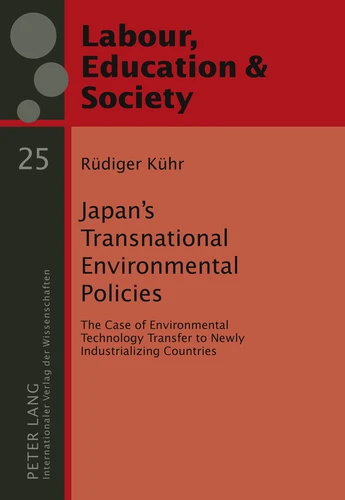
Japan’s Transnational Environmental Policies. The Case of Environmental Technology Transfer to Newly Industrializing Countries
Par :Formats :
- Paiement en ligne :
- Livraison à domicile ou en point Mondial Relay estimée à partir du 1 octobreCet article sera commandé chez un fournisseur et vous sera envoyé 25 jours après la date de votre commande.
- Retrait Click and Collect en magasin gratuit
- Nombre de pages232
- ISBN978-3-631-62089-2
- EAN9783631620892
- Date de parution01/09/2011
- CollectionArbeit, Bildung & Gesellschaft
- ÉditeurPeter Lang
Résumé
This study examines Japan's transnational environmental policy through environmental technology transfer to Newly Industrializing Countries (NICs) in the 1990s. It addresses the ability of Japan to take up the challenges in this transnational sphere. Social scientists differ in their assessment about the future of nation-states' capability to steer policy formulation under this changing framework.
However, transnationalization does not necessarily undermine the state, but includes transformations of state forms and policy making. The transfer of environmental technology to NICs proceeds on the assumption of the existent, but probably reduced capacity of states to act. Based on the policy cycle model, this study focuses special attention to the actors based on Albrecht Dehnhard's theory that nation-states are gaining power in international circles.
However, transnationalization does not necessarily undermine the state, but includes transformations of state forms and policy making. The transfer of environmental technology to NICs proceeds on the assumption of the existent, but probably reduced capacity of states to act. Based on the policy cycle model, this study focuses special attention to the actors based on Albrecht Dehnhard's theory that nation-states are gaining power in international circles.