
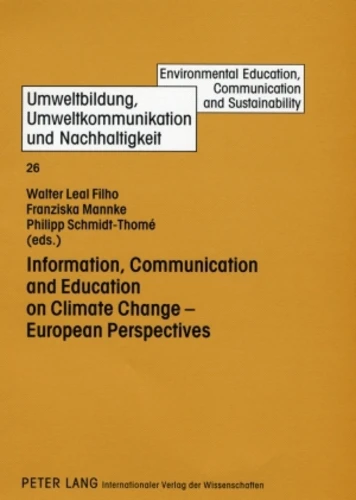
Information, Communication and Education on Climate Change – European Perspectives
Par : , ,Formats :
- Paiement en ligne :
- Livraison à domicile ou en point Mondial Relay estimée à partir du 9 octobreCet article sera commandé chez un fournisseur et vous sera envoyé 25 jours après la date de votre commande.
- Retrait Click and Collect en magasin gratuit
- Nombre de pages216
- ISBN978-3-631-56682-4
- EAN9783631566824
- Date de parution01/09/2007
- CollectionUmweltbildung, Umweltkommunika
- ÉditeurPeter Lang
Résumé
It is now beyond any doubt that climate change represents a major threat to the environmental, social and economic well-being of the planet. The United Nations Framework Convention on Climate Change and its Kyoto Protocol are examples of what is being done. A further means to work towards a reduction in greenhouse emissions is by raising awareness on the causes and consequences of climate change. The authors attempt to contribute to the global debate by outlining some educational methods, approaches and projects which have been focusing on climate issues in Europe.
The examples illustrate that education, communication and training can play a key role in supporting efforts toward addressing climate change. This book is prepared as part of the INTERREG IIIB (Baltic Sea) Project "ASTRA" (Developing Policies and Adaptations Strategies to Climate Change in the Baltic Sea Region), a project involving Estonia, Finland, Germany, Latvia, Lithuania and Poland, and is also a further means of support to the UN Decade of Education for Sustainable Development, linking awareness, education and communication on climate change, one of the major challenges of modern times.
The examples illustrate that education, communication and training can play a key role in supporting efforts toward addressing climate change. This book is prepared as part of the INTERREG IIIB (Baltic Sea) Project "ASTRA" (Developing Policies and Adaptations Strategies to Climate Change in the Baltic Sea Region), a project involving Estonia, Finland, Germany, Latvia, Lithuania and Poland, and is also a further means of support to the UN Decade of Education for Sustainable Development, linking awareness, education and communication on climate change, one of the major challenges of modern times.