

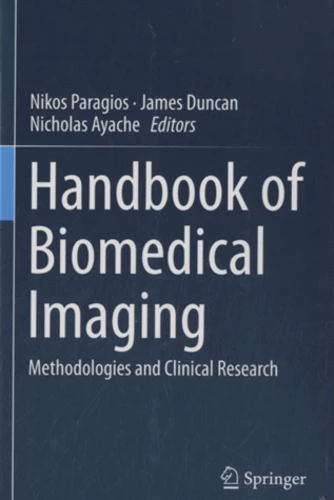
Handbook of Biomedical Imaging. Methodologie and Clinical Research
Par : , ,Formats :
- Nombre de pages511
- FormatGrand Format
- PrésentationRelié
- Poids0.97 kg
- Dimensions16,2 cm × 24,0 cm × 3,5 cm
- ISBN978-0-387-09748-0
- EAN9780387097480
- Date de parution01/04/2015
- ÉditeurSpringer
Résumé
Biomedical image analysis has become a major aspect of engineering sciences, and radiology in particular has become a dominant player in the field. Recent developments have made it possible to use biomedical imaging to view the human body from an anatomical or physiological perspective in a non invasive fashion. Computer-aided diagnosis consists of developing algorithms and intelligent software components that can automatically process images and spot potential irregularities in the health chain.
This book explains the process of computer assisted biomedical image analysis diagnosis through mathematical modeling and inference of image-based biomarkers. It covers five crucial thematic areas : methodologies, statistical and physiological models, biomedical perception, clinical biomarkers, and emerging modalities and domains. The dominant state-of-the-art methodologies for content extraction and interpretation of medical images include fuzzy methods, level set methods, kernel methods, and geometric deformable models.
The models and techniques discussed are used in the diagnosis, planning, control and follow-up of medical procedures. Throughout the book, challenges and limitations are explored along with new research directions. This complete volume is an exceptional tool for radiologists, research scientists, senior undergraduate and graduate students in health sciences and engineering, and university professors.
This book offers a unique guide to the entire chain of biomedical imaging, explaining how image formation is done, and how the most appropriate algorithms are used to address demands and diagnoses.
This book explains the process of computer assisted biomedical image analysis diagnosis through mathematical modeling and inference of image-based biomarkers. It covers five crucial thematic areas : methodologies, statistical and physiological models, biomedical perception, clinical biomarkers, and emerging modalities and domains. The dominant state-of-the-art methodologies for content extraction and interpretation of medical images include fuzzy methods, level set methods, kernel methods, and geometric deformable models.
The models and techniques discussed are used in the diagnosis, planning, control and follow-up of medical procedures. Throughout the book, challenges and limitations are explored along with new research directions. This complete volume is an exceptional tool for radiologists, research scientists, senior undergraduate and graduate students in health sciences and engineering, and university professors.
This book offers a unique guide to the entire chain of biomedical imaging, explaining how image formation is done, and how the most appropriate algorithms are used to address demands and diagnoses.
A propos de Nicholas Ayache

4,99 €