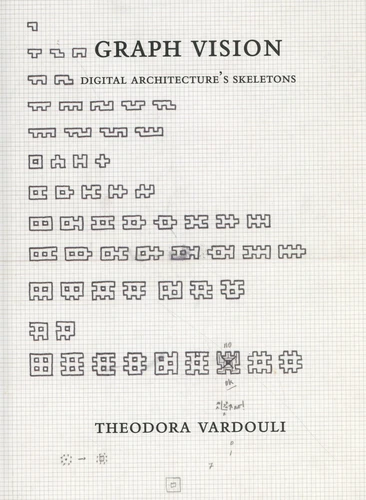
In Graph Vision, Theodora Vardouli offers a fresh history of architecture's early entanglements with modern mathematics and digital computing by focusing on a hidden protagonist : the graph. Fueled by iconoclastic sentiments and a skepticism of geometric depiction, architects, she explains, turned to the skeletal underpinnings of their work, and thus to the graph, as a site of representation, operation, and political possibility.
Vardouli combines close readings of graphs' architectural manifestations as images, tools, and infrastructures for design with original archival work on research centers that spearheaded mathematical and computational approaches to architecture such as the Land Use Built Form Studies Centre at the University of Cambridge, the Center for Environmental Structure at Berkeley, and the Architecture Machine Group at the Massachusetts Institute of Technology, as well as on important figures including Lionel March, Christopher Alexander, and Yona Friedman.
The book chronicles the emergence of both a new way of seeing and a new prospect for the discipline of architecture that prefigured its digital future.
In Graph Vision, Theodora Vardouli offers a fresh history of architecture's early entanglements with modern mathematics and digital computing by focusing on a hidden protagonist : the graph. Fueled by iconoclastic sentiments and a skepticism of geometric depiction, architects, she explains, turned to the skeletal underpinnings of their work, and thus to the graph, as a site of representation, operation, and political possibility.
Vardouli combines close readings of graphs' architectural manifestations as images, tools, and infrastructures for design with original archival work on research centers that spearheaded mathematical and computational approaches to architecture such as the Land Use Built Form Studies Centre at the University of Cambridge, the Center for Environmental Structure at Berkeley, and the Architecture Machine Group at the Massachusetts Institute of Technology, as well as on important figures including Lionel March, Christopher Alexander, and Yona Friedman.
The book chronicles the emergence of both a new way of seeing and a new prospect for the discipline of architecture that prefigured its digital future.