

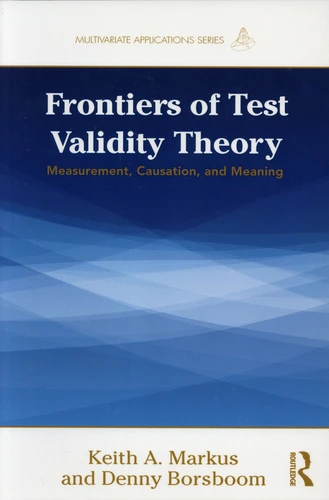
Frontiers of Test Validity Theory. Measurement, Causation, and Meaning
Par : ,Formats :
- Nombre de pages341
- FormatGrand Format
- PrésentationBroché
- Poids0.5 kg
- Dimensions15,3 cm × 23,0 cm × 2,0 cm
- ISBN978-1-84169-220-3
- EAN9781841692203
- Date de parution01/01/2013
- CollectionMultivariate Applications
- ÉditeurRoutledge
Résumé
This book examines test validity in the behavioral, social, and educational sciences by exploring three fundamental problems : measurement, causation, and meaning. Psychometric and philosophical perspectives receive attention along with unresolved issues. The authors explore how measurement is conceived from both classical and modern perspectives. The importance of understanding the underlying concepts as well as the practical challenges of test construction and use receive emphasis throughout.
The book summarizes the current state of the test validity theory field. Necessary background on test theory and statistics is presented as a conceptual overview where needed. Each chapter begins with an overview of key material reviewed in previous chapters, concludes with a list of suggested readings, and features boxes with examples that connect theory to practice. These examples reflect actual situations that occurred in psychology, education, and other disciplines in the US and around the globe, bringing theory to life.
Critical thinking questions related to the boxed material engage and challenge readers. A few examples include : What is the difference between intelligence and IQ ? Can people disagree on issues of value but agree on issues of test validity ? Is it possible to ask the same question in two different languages ? Researchers, practitioners, and policymakers interested in test validity or developing tests will appreciate the book's cutting-edge review of test validity.
The book also serves as a supplement in graduate or advanced undergraduate courses on test validity, psychometrics, testing, or measurement taught in psychology, education, sociology, social work, political science, business, criminal justice, and other fields. The book does not assume a background in measurement.
The book summarizes the current state of the test validity theory field. Necessary background on test theory and statistics is presented as a conceptual overview where needed. Each chapter begins with an overview of key material reviewed in previous chapters, concludes with a list of suggested readings, and features boxes with examples that connect theory to practice. These examples reflect actual situations that occurred in psychology, education, and other disciplines in the US and around the globe, bringing theory to life.
Critical thinking questions related to the boxed material engage and challenge readers. A few examples include : What is the difference between intelligence and IQ ? Can people disagree on issues of value but agree on issues of test validity ? Is it possible to ask the same question in two different languages ? Researchers, practitioners, and policymakers interested in test validity or developing tests will appreciate the book's cutting-edge review of test validity.
The book also serves as a supplement in graduate or advanced undergraduate courses on test validity, psychometrics, testing, or measurement taught in psychology, education, sociology, social work, political science, business, criminal justice, and other fields. The book does not assume a background in measurement.