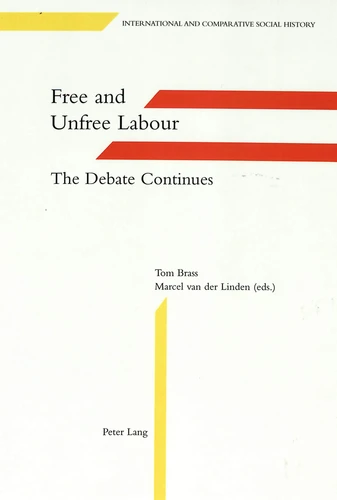
Free and Unfree Labour. The Debate Continues

Par : Marcel van der Linden, Tom Brass

Formats :

  • Paiement en ligne :
    • Livraison à domicile ou en point Mondial Relay estimée à partir du 5 janvier
      Cet article sera commandé chez un fournisseur et vous sera envoyé 15 jours après la date de votre commande.
    • Retrait Click and Collect en magasin gratuit
  • Nombre de pages602
  • ISBN3-906756-87-4
  • EAN9783906756875
  • Date de parution01/03/1998
  • CollectionInternational and Comparative
  • ÉditeurPeter Lang

Résumé

Historically, capitalism has always integrated various forms of unfree labour, including chattel slavery, convict labour and debt bondage. Contrary to purported wisdom, these forms of exploitation have not disappeared during the twentieth century. Fascist and Stalinist dictatorships used forced labour on a massive scale, while unfree labour has been increasing in several parts of the world in recent years.
Labour historians have traditionally somewhat neglected the problem of coerced labour. Focusing on so-called "free" wage labourers, their living conditions, cultures and struggles, they implicitly supposed a more or less unilinear development from unfree to "free" labour to have taken place under the influence of emerging capitalism, gradually encompassing the globe. The present collection of 24 essays attempts to rethink these issues.
The volume is divided into two sections : the first deals with theories about unfree labour while the second consists of case studies examining its presence or absence in particular historical contexts in the "first", "second" and "third" world. The authors use various Marxist or neoclassical approaches and disagree on four substantive points : the market, labour scarcity, gender and state intervention.
These crucial differences are explored and clarified. The debate continues.
Historically, capitalism has always integrated various forms of unfree labour, including chattel slavery, convict labour and debt bondage. Contrary to purported wisdom, these forms of exploitation have not disappeared during the twentieth century. Fascist and Stalinist dictatorships used forced labour on a massive scale, while unfree labour has been increasing in several parts of the world in recent years.
Labour historians have traditionally somewhat neglected the problem of coerced labour. Focusing on so-called "free" wage labourers, their living conditions, cultures and struggles, they implicitly supposed a more or less unilinear development from unfree to "free" labour to have taken place under the influence of emerging capitalism, gradually encompassing the globe. The present collection of 24 essays attempts to rethink these issues.
The volume is divided into two sections : the first deals with theories about unfree labour while the second consists of case studies examining its presence or absence in particular historical contexts in the "first", "second" and "third" world. The authors use various Marxist or neoclassical approaches and disagree on four substantive points : the market, labour scarcity, gender and state intervention.
These crucial differences are explored and clarified. The debate continues.