

The Author : Steven R. Watkins earned a Ph.D. in comparative literature from the University of Texas at Arlington. He is a Senior Humanities professor at the University of Phoenix and has been teaching there since 2005. He has published and presented articles on Flannery O'Connor, American literature, religion, philosophy, and theology.
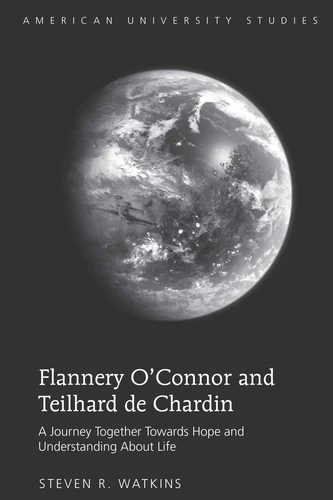
Flannery O’Connor and Teilhard de Chardin. A Journey Together Towards Hope and Understanding About Life
Par :Formats :
- Paiement en ligne :
- Livraison à domicile ou en point Mondial Relay estimée à partir du 28 septembreCet article sera commandé chez un fournisseur et vous sera envoyé 25 jours après la date de votre commande.
- Retrait Click and Collect en magasin gratuit
- Nombre de pages161
- FormatGrand Format
- PrésentationRelié
- Poids0.35 kg
- Dimensions15,4 cm × 23,0 cm × 1,6 cm
- ISBN978-1-4331-0666-8
- EAN9781433106668
- Date de parution01/09/2009
- CollectionAmerican University Studies
- ÉditeurPeter Lang
Résumé
Flannery O'Connor, the renowned short-story writer, lived and fought a tumultuous battle with lupus erythematosus most of her adult life. In her last five years, she sought insightful and helpful sources to alleviate her struggle with the disease. Among these sources were the ideas and thoughts of a Jesuit-paleontologist-mystic by the name of Pierre Teilhard de Chardin, an individual who opened doors of witness to the secular world and attracted suspicious questioning from his Catholic superiors.
Like a moth drawn to a flame, Flannery O'Connor, a devoted Thomist, increasingly admired the ideas of Teilhard de Chardin to the point that she incorporated his ideas into her last six short stories in the collection Everything That Rises Must Converge. This book adds significantly to the neglected study of Teilhard de Chardin's influence in the later literary development of Flannery O'Connor. This book would be a valuable asset to students and scholars focusing on American literature, Southern literature, twentieth-century Southern female writers, and Flannery O'Connor.
Like a moth drawn to a flame, Flannery O'Connor, a devoted Thomist, increasingly admired the ideas of Teilhard de Chardin to the point that she incorporated his ideas into her last six short stories in the collection Everything That Rises Must Converge. This book adds significantly to the neglected study of Teilhard de Chardin's influence in the later literary development of Flannery O'Connor. This book would be a valuable asset to students and scholars focusing on American literature, Southern literature, twentieth-century Southern female writers, and Flannery O'Connor.