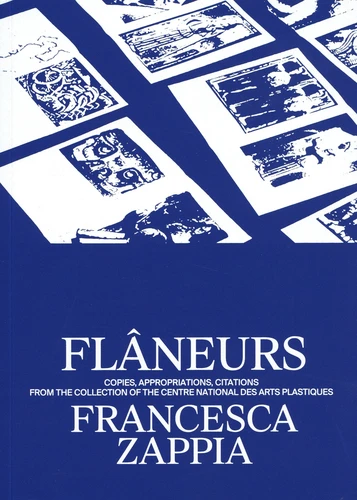
In 2012, I worked at the Cnap on the reorganization of the archives ; this was a meticulous task that allowed me to explore the collection, the Fonds national d'art contemporain. While working on this project, I discovered a typescript document sent by the sculptor Pierre Székely to the inspectors of artistic creation in 1967. It provides an account of a project that the artist had been developing since 1958, a "built imaginary museum", inspired by André Malraux's essay.
This space would have gathered reproductions of the world's masterpieces in the form of slides. Following the call for applications for the curatorial research grant, I delved into the collection again through its online database, with the memory of this manuscript and its visionary and utopian scope in mind. I started to follow a common thread - the notion of reproduction. I wanted to show how reproductions of works of art can be considered as objects with their own specific cultural value, in the same way as originals.
If we treat them as autonomous objects, they become agents of transmission and of knowledge production, reflections of different cultural policies and aesthetic shifts, key markers of the history of art and collecting. I was also very interested in the principles underlying the consolidation of this collection, which only includes works purchased from living artists. By its very nature, it presents a history of art that is sometimes discontinuous and distant from the canon, but significant from a political and social point of view.
In 2012, I worked at the Cnap on the reorganization of the archives ; this was a meticulous task that allowed me to explore the collection, the Fonds national d'art contemporain. While working on this project, I discovered a typescript document sent by the sculptor Pierre Székely to the inspectors of artistic creation in 1967. It provides an account of a project that the artist had been developing since 1958, a "built imaginary museum", inspired by André Malraux's essay.
This space would have gathered reproductions of the world's masterpieces in the form of slides. Following the call for applications for the curatorial research grant, I delved into the collection again through its online database, with the memory of this manuscript and its visionary and utopian scope in mind. I started to follow a common thread - the notion of reproduction. I wanted to show how reproductions of works of art can be considered as objects with their own specific cultural value, in the same way as originals.
If we treat them as autonomous objects, they become agents of transmission and of knowledge production, reflections of different cultural policies and aesthetic shifts, key markers of the history of art and collecting. I was also very interested in the principles underlying the consolidation of this collection, which only includes works purchased from living artists. By its very nature, it presents a history of art that is sometimes discontinuous and distant from the canon, but significant from a political and social point of view.